


Qatar out to prove WC worth
Hosting the Asian Cup for the second time in their history, Qatar will find themselves under greater scrutiny than ever before after their shock victory in the race to hold the 2022 World Cup.

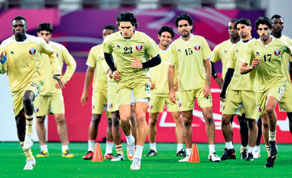
Qatar striker Sebastien Soria (No 23) and his teammates participate in a team training session on the eve of their Asian Cup opening match against Uzbekistan. PICTURE: Noushad
While the tournament provides the country with a chance to prove its capacity to organise the sport’s showpiece event, the national team will look to demonstrate that they are worthy of a World Cup-hosting nation.
Their previous best showing in the Asian Cup was a quarter-final exit at the hands of China in 2000.
In their six other appearances at the Asian football summit—including one as hosts in 1988 - they have failed to progress beyond the group phase.
Qatar raise the curtain on the Asian Cup against Uzbekistan today and French coach Bruno Metsu will hope that fortune shines more favourably on his charges than it has in recent months.
The ‘Annabi’ (Maroon) competed in both the Gulf Cup of Nations and the Asian Games football tournament towards the end of 2010, and crashed out of both tournaments in agonising fashion.
At the Gulf Cup in Yemen, Qatar went into their final group game against Saudi Arabia needing victory to reach the knockout phase.
Qatar appeared to be on the brink of the last four after Ibrahim Al-Ghanim gave them the lead with six minutes to play, but an 89th-minute own goal by Hamed Shami Zaher allowed the Saudis to snatch a 1-1 draw that took them through at Qatar’s expense.
As defending champions, Qatar’s under-23 side topped their Asian Games group ahead of Kuwait, India and Singapore, but misfortune befell them in the last 16.
A 1-0 loss to Uzbekistan saw Qatar eliminated, but a shocking extra-time miss by 18-year-old striker Fahad Khalfan—who toed the ball against the post from a yard out—meant their exit was accompanied by an unwanted dose of worldwide humiliation.
Recent results may be chequered, but in Metsu Qatar possess a coach who is something of an authority on making a splash at major tournaments.
The 56-year-old Frenchman was at the helm when Senegal stunned holders France in the opening game of the 2002 World Cup.
Youthful China look to future
China’s squad for the Asian Cup is the youngest in the team’s history, but after a number of breakthroughs in 2010 there is a renewed air of optimism around the continent’s perennial under-achievers.
Last year marked a series of firsts for Gao Hongbo’s side.
Their 3-0 defeat of South Korea at the East Asian Football Championship in February was their first victory over their rivals in 28 attempts, and set China on the path to their second triumph in the regional event.
They missed out on a place at the World Cup in South Africa, but a shock 1-0 win over France on the island of Reunion in June was the most sensational result of the pre-tournament friendly matches.
China’s under-23 side fell to South Korea in the last 16 at the Asian Games in November, but they ended the year strongly and Deng Zhuoxiang’s stoppage-time penalty in the 1-0 defeat of Macedonia on December 23 brought China a fourth victory from five Asian Cup warm-up games.
“They have prepared well and they have a good balance between youth and experience,” said well-travelled former China coach Bora Milutinovic.
“When I watch this team and I see the names of Du Wei and Qu Bo, for me it’s a special sensation because they started to play with me 10 years ago when I was China coach and it’s very exciting.”
The average age of the squad for the Asian Cup is just 24, as China embark on a long-term plan with qualification for the 2014 World Cup in Brazil as its objective.
“The ultimate goal for this young senior team is to make the 2014 World Cup,” Cao Jingwei, a Chinese Football Association official, told the China Daily last month. “The Asian Cup is just a test.”
Gao took over as coach in May 2009 and has overseen a steady rise up the FIFA world rankings from 108 to a current position of 87.
Despite the improvement, however, recent results have not been able to satisfy the fans’ high expectations of the national side.
The failure to qualify for the World Cup and poor performances at the Beijing Olympics turned the team into something of a laughing stock among fans—who booed during the loss to South Korea at the Asian Games.
Preparations for the Asian Cup have also been overshadowed by a probe into corruption and match-fixing in Chinese football, which has resulted in the arrests of two former association heads and a number of lower-level officials.
China have made nine previous appearances at the Asian Cup but the closest they have come to tasting success is runners-up finishes in 1984 and 2004.
They were beaten 3-1 by Japan on home soil in the final of the 2004 tournament, in a game that sparked rioting by irate Chinese fans outside Beijing’s Workers Stadium at the final whistle.
There was huge disappointment at the last tournament in 2007, meanwhile, after a 3-0 defeat by Uzbekistan in Malaysia confirmed China’s departure at the group stage.
Uzbeks pursue upward curve
Uzbekistan may not have made their Asian Cup debut until 1996, but they have improved with each participation and will be aiming for a last-four place at the 2011 tournament.
Eliminated in the group phase on their competition debut 15 years ago, the Central Asian heavyweights suffered the same fate four years later but have since reached the quarter-finals at successive tournaments.
Their showing at the 2007 event in Indonesia, Malaysia, Thailand and Vietnam proved their emerging pedigree, as they ousted China in the group phase before falling to eventual finalists Saudi Arabia in the last eight.
Uzbekistan coach Vadim Abramov ran training camps in Tunisia and the United Arab Emirates in preparation for the Qatar competition and says his players have quickly established an understanding.
“The language of football is one and, to understand each other, the players do not need to have that much time,” he told the Asian Football
Confederation’s official website.
“Let’s just say that those players who are joining the team for the camp (in the UAE) are considered to have more talent, but how they perform within the team depends entirely on them.”
Uzbekistan won the Asian Games football tournament on their debut appearance in 1994 and their under-23 side reached the last eight at the most recent event in China in November. Having squeezed into the knockout phase by finishing third in their group—behind the UAE and Hong Kong—they edged Qatar 1-0 in the last 16 before falling 3-1 to South Korea after extra time in the quarter-finals.
Abramov’s side will cross swords with Qatar again when they tackle the hosts in the tournament’s opening game at Doha’s Khalifa International Stadium on January 7.
China and recently crowned Gulf Cup of Nations champions Kuwait complete the Group A line-up.
Kuwait look for more trophies
Kuwait may be the bottom seeds in Group A, but few teams will enter the Asian Cup with as much recent experience of lifting silverware as Goran Tufegdzic’s rejuvenated outfit.
‘Al Azraq’ (The Blues), who begin their campaign against China on January 8, will be bidding to start the year in positive fashion after ending a long, 12-year wait for silverware in 2010.
In October they won the West Asian Football Federation Championship on their maiden appearance, defeating defending champions Iran 2-1 in the final in Jordan.
They took their momentum into the Gulf Cup of Nations in Yemen at the end of the year and emerged with their 10th trophy in the event’s history—and first since 1998 -- after Walid Ali Jumah’s extra-time long-ranger earned a 1-0 victory over Saudi Arabia in the final.
Key to the upturn in the country’s fortunes has been inspirational Serbian coach Tufegdzic.
The 39-year-old was promoted from his role as assistant coach in February 2009 and within 20 months he had ended a trophy drought stretching back to Kuwait’s previous Gulf Cup success under Czech coach Milan Macala in 1998.