


Reuters/Shanghai/Dalian
A major Chinese steelmaker said yesterday it has halted production at a loss-making plant and expressed doubt that government attempts to stimulate the slowing economy would revive demand in the world’s biggest market for the metal.

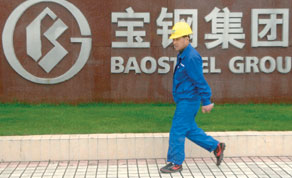
A labourer walks past the gate of the headquarters of Baosteel Group Corp in Shanghai. China’s biggest listed steelmaker said it has suspended production at a loss-making plant in Shanghai, in a sign of the intense pressure on the sector as steel prices trade near three-year lows
With China’s slowing growth sapping demand for new ships and construction, an industry official said more than a third of the country’s iron ore mines were idle due to depressed prices, and the top steel producer also forecast lower output this year.
Beijing approved infrastructure projects worth around $160bn this month. However, officials at a steel industry conference in the city of Dalian expressed doubt about how much the plans to build highways, ports and airport runways would boost demand.
China’s biggest listed steelmaker, Baoshan Iron & Steel Co, said it has suspended output at a 3mn tonne-a-year plant in Shanghai as steel prices near three-year lows.
“The government’s infrastructure investment may only improve sentiment ... I don’t expect a big lift in steel demand,” Zhang Dianbo, assistant president of Baosteel, told reporters.
Baosteel is one of the first major Chinese mills to announce it is suspending production. But more suspensions are likely as the world’s second-biggest economy cools and banks restrict lending to an industry that built up $400bn of debt during years of double-digit growth.
At the conference a senior executive of China’s overall number one producer, Hebei Iron & Steel Group, said the company had also cut production and expected total 2012 output to fall from last year’s 44.7mn tonnes.
Despite the gloom, the world’s top iron ore miner Vale of Brazil said it was pushing ahead with projects to expand production which would rise to a forecast 320mn tonnes next year from 312mn tonnes in 2012.
Vale sees China’s steel output rising between 3% and 5% next year. Jose Carlos Martins, executive director of its ferrous and strategy division, said he was not fretting about iron ore prices, which are down a fifth since the start of the year to around $104 a tonne.
“I believe that prices will stay around this level for a while - at between $100 and $120 ... with a lot of volatility,” Martins told reporters on the sidelines of the conference. “Being a low-cost producer and being focused on cost and quality, we believe that no matter the growth, we see space for our company, our projects and our ore to get the market.”
Global miners Rio Tinto and BHP Billiton said they remained confident about China’s long-term demand outlook, with BHP predicting iron ore demand there wouldn’t peak until 2025.
However, the slide in iron ore prices has shut many high-cost producers out of the market, particularly in China which produces about 1bn tonnes a year itself and buys 60% of the ore that is traded globally.
About 40% of China’s iron ore mines have suspended operations, Liu Xiaoliang, executive deputy secretary general of the Metallurgical Mines Association of China, told the conference.
Zhang Changfu, vice-chairman of the China Iron and Steel Association (CISA), said the low prices had already affected the construction of new iron ore projects, adding that average costs were around $80 per tonne. “The tax burden on domestic iron ore development is very heavy and there are all sorts of charges. We are calling on the government to cut taxes,” Zhang told reporters.
The drop in China’s steel demand has driven Shanghai rebar futures prices down by more than a fifth this year to as low as 3,206 yuan a tonne, and hit demand for iron ore, sending prices of the main steel raw material to 3-year lows below $87 a tonne this month.
Iron ore prices have bounced back to above $100 a tonne, but are still almost a third off this year’s peak.
At current prices, iron ore still fetches more than twice what it costs Vale, Rio Tinto and BHP Billiton to mine it. But fourth-ranked iron ore miner Australia’s Fortescue Metals Group slammed the brakes this month on plans to treble its iron ore capacity, cutting $1.6bn in planned capital spending this year, and axing hundreds of jobs.
The Baosteel plant, in Shanghai’s Luojing district, produces steel plate used in the construction industry and for making ships and oil rigs. The company, which bought the plant for 14bn yuan in 2008, said it had been losing money due to weak demand and high costs.
A Baosteel source who has worked at the plant told Reuters the facility would eventually be shut as part of broader plans to relocate operations away from Shanghai.
Chinese steelmakers, already battling overcapacity, have been struggling with razor-thin profits or losses since Beijing clamped down on the real estate sector, hitting steel demand.