


Reuters/Stavanger, Norway
A change in strategy to take on big risks has transformed Norway’s Statoil into one of the world’s top explorers for oil and gas in the past 18 months, with a series of big discoveries from Brazil to Tanzania to the North Sea.

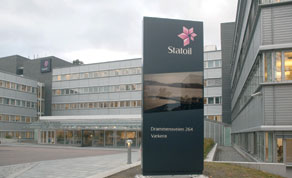
The headquarters of Statoil in Oslo, Norway. Statoil’s shares have gained 16% over the past 12 months even as oil prices are trading in line with their level a year ago. Its market capitalisation has risen to $83bn, making it the biggest company in the Nordic region, and it has jumped to 40 on the Fortune 500 Global list from 67 last year
The question now is how long Statoil can keep it up.
Tim Dodson, its head of exploration, says the company’s current run has nothing to do with luck, but he is also careful to play down expectations, given the inherent uncertainty of exploration.
“If we believe in our own analysis, it will be very difficult to maintain the rate of discovery and success,” Dodson said in an interview. “We’re more likely to not succeed in the Faeroe; we’re more likely not to succeed in Greenland and in Suriname.”
Statoil’s recent success is a far cry from 2010, when the state-controlled company was struggling with dwindling output and reserves. On its home turf, top oil companies had given up exploring the North Sea, where fields were seen as mature or depleted.
“The perception was that they’re essentially a government-owned monopoly, the Norwegian North Sea was in permanent decline and they were there because of their government ownership,” said Ashley Heppenstall, chief executive of Lundin Petroleum.
Statoil was spending a lot on exploration but would not take big risks, and its relatively small finds were not enough to replace output.
“What concerned me is that we were drilling very few high-impact, large-opportunity wells, almost none. So if you’re not drilling any, you won’t find many,” Dodson said.
With the new strategy, which took effect at the start of 2011, Statoil restructured to elevate exploration into a separate division, gave Dodson more power to take on ventures and launched a global exploration spree.
Since then, its reserve replacement ratio, which indicates how much oil a company finds in comparison with its production, jumped to 117% last year from 79% in 2009 and outpaced BP’s 103% and Royal Dutch Shell’s 99%.
Statoil’s own calculations indicate it has been the second most successful explorer in the world since 2010, beaten only by Eni.
“Whether they can sustain this, I’m not sure. That would be too good to be true,” Anne Gjoeen, an analyst with Handelsbanken said. “But they said they can stay above 100% for the next 10 years, and I think that’s realistic.”
Statoil’s shares have gained 16% over the past 12 months even as oil prices are trading in line with their level a year ago.
Its market capitalisation has risen to $83bn, making it the biggest company in the Nordic region, and it has jumped to 40 on the Fortune 500 Global list from 67 last year.
“The only thing that annoys me is that we got it wrong last year; we found much more than our own analysis suggested,” Dodson said.
“Sometimes it will appear we are going here, there, and everywhere. But we’re not, it is a result of a very systematic process,” he added.
Statoil scored its biggest find - and the biggest by any company last year - on its home turf in the North Sea, in an area which had been shunned by major explorers.
The area got a new lease on life after a regulatory change encouraged exploration and then a slew of smaller players forced Statoil into intense competition on its home turf.
“Everybody thought, ‘It’s over, it’s the sunset years ...’, but there was never a sunset, it was actually a sunrise. Some people can’t tell the difference between morning and evening,” said Erik Haugane, chief executive of Det Norske.
“The success of Statoil in Norway is a result of the increased competition, and their international success was based on the belief that their Norwegian business was in a decline,” he added.
Among its endeavours abroad this year, Statoil has made the top bid in the first US federal auction for drilling rights in the Gulf of Mexico since the 2010 Macondo accident; gained key licenses in Angola and signed a massive Arctic exploration deal with Russia’s Rosneft.
The firm has also become a major player in the US shale industry, picking up major positions in the Eagle Ford basin in Texas and the Bakken area in Montana, and it aims to increase US shale output to over a tenth of its total production by 2020.
“It’s very simple. It’s about gaining access earlier to larger opportunities, like we’ve done in Tanzania, Mozambique, like we’ve done in Angola, like we’ve done with Rosneft in Russia,” Dodson said. “So we start earlier and take bigger positions.”
The early start is relatively cheap, but the risks and future costs are high.
Statoil’s capital spending is jumping to $18bn this year from $13.7bn just two years ago.
Analysts expect the figure to keep on rising, given its plans to increase output to 2.5mn barrels of oil equivalent per day by 2020 from around 2mn this year, but that is not seen as a bad thing.
“They have a good portfolio of opportunities, and they are finally exploiting their potential,” said Carnegie analyst Martin Vold. “Much of their exploration success of the past year hasn’t even been included in their 2P (proven and probable) reserves.”