


Bloomberg/New Delhi
India’s biggest builders of roads, bridges and metro networks are resorting to asset sales to fund projects after exhausting bank credit limits amid the highest borrowing costs among Asia’s major economies.

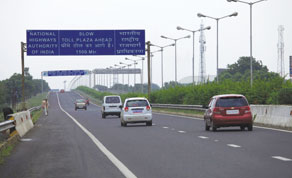
Vehicles travel along the expressway in Ahmedabad, Gujarat, India (file). Prime Minister Manmohan Singh’s plan to attract $1tn in infrastructure investments by 2017 and boost economic growth to 9% is at risk after five-year AAA company bond yields rose 41 basis points from this year’s low to 9.69%, more than twice the levels in China
Larsen & Toubro Ltd, Asia’s largest engineering company by market value, is reducing its holding in unit L&T Infrastructure Development Projects Ltd to raise cash, chairman AM Naik said on August 24. Reliance Infrastructure Ltd plans to offer as much as 25% of its shares, according to its annual report. Punj Lloyd Ltd will sell assets including properties in six to nine months, director of corporate affairs Luv Chhabra said on August 8.
Prime Minister Manmohan Singh’s plan to attract $1tn in infrastructure investments by 2017 and boost economic growth to 9% is at risk after five-year AAA company bond yields rose 41 basis points from this year’s low to 9.69%, more than twice the levels in China. The government fell short of targets in obtaining bids for new road projects last quarter as banks cut lending to the industry after reaching regulatory limits on loans, Transport Minister CP Joshi said on August 27.
“Times are tough for infrastructure companies,” Arun Kejriwal, director in Mumbai at Kejriwal Research & Investment Services Pvt., said in an interview on Thursday. “Companies are seeking shareholders’ approvals for stake sales so they can raise funds when needed. They have no other choice because banks aren’t going to lend and borrowing costs are high anyway.”
India’s failure to meet goals to expand transportation networks is threatening an economy that is already growing at a pace that is near the slowest since 2009. Gross domestic product probably gained 5.5% in the three months ended June 30, a report showed yesterday, compared with the preceding period’s 5.3% gain that was the smallest in 12 quarters.
Ashoka Buildcon Ltd, an Indian builder, raised $150mn by selling a stake in unit Ashoka Concessions Ltd to private equity investors Macquarie SBI Infrastructure Fund and SBI Macquarie Infrastructure Trust, according to a statement from the company on August 13.
Punj Lloyd, India’s third-largest engineering company, is also considering an initial offering of shares in Singapore-based unit Sembawang Corp and will use the funds to repay borrowings, according to Chhabra. GMR Infrastructure Ltd plans to sell its shares as well as a stake in subsidiary GMR Highways Ltd to reduce debt, the Business Standard reported on August 29.
Larsen and Toubro has liabilities equivalent to 118% of its share capital while the debt to equity ratio is 132% at Punj Lloyd and 176% at IRB Infrastructure Developers Ltd, the latest data compiled by Bloomberg show. A similar gauge is 0.9% for South Korea’s Hyundai Engineering & Construction Co and negative 30% for Samsung Engineering Co.
Banks are scaling back lending to companies and industries that have relatively high levels of debt as the economic slowdown erodes the repayment ability of borrowers and boosts bad debt, according to Dhananjay Mishra, an analyst at Mumbai based brokerage Sushil Finance Consultants Ltd.
Indian banks’ soured loans may jump to 4.6% of total advances in the year through March 2013 from 2.9% in the prior period in a “severe-risk scenario,” the Reserve Bank of India said in a report on June 28.
The bad-credit ratio rose to 4.99% last quarter at State Bank of India, the nation’s largest lender, from 3.52% a year earlier, according to a statement on August 13.
“There are lots of non-performing assets across banks and they are naturally stringent in lending,” said Sushil Finance’s Mishra. “Smaller players in the infrastructure sector will find it difficult to raise debt because of this.”
Borrowing costs in India have remained at the highest level among the region’s investment-grade economies after central bank governor Duvvuri Subbarao refrained from joining counterparts from Brazil to China and South Korea last month in easing policy to spur growth. The RBI can only consider cutting rates when inflation, which averaged 7.3% this year, shows “very sustainable signs of moving down,” deputy governor Subir Gokarn said on August 19.
Indian builders of roads and ports may face difficulties in raising funds from the international debt market as the nation faces the risk of a downgrade in its sovereign rating, according to Mumbai-based Angel Broking Ltd.
Weak public finances, slowing growth and a record current- account deficit prompted Standard & Poor’s and Fitch Ratings to lower their outlooks for India’s sovereign rating to negative from stable since April, pushing the nation a step closer to junk status. That sent the rupee, Asia’s worst-performing currency of the past year with a 17% loss, to an all-time low of 57.3275 per dollar on June 22.
RBI governor Subbarao said this week that India needs to prepare for a downgrade in its credit rating.
“It is still possible that we’ll maintain this rating,” Subbarao said on August 28 in a speech at Cornell University in Ithaca, New York. “However, we need to prepare for” any downgrade and an outflow of investment.
Bond risk for Indian companies has jumped almost 80% since the start of 2011. The average cost of five-year credit- default swaps insuring against non-payment by seven local issuers climbed 161 basis points to 358, according to data provider CMA, which is owned by McGraw-Hill Cos and compiles prices quoted by dealers in privately negotiated markets.
“With a rating downgrade looming, I’m not sure infrastructure companies will be able to raise international loans at favourable rates,” said P Phani Sekhar, a trader in Mumbai at Angel Broking. “If there were to be some negative rating action, then it would become much more difficult to raise money.”