Reuters/Stavanger/London
A Qatari project that has been a drain on Royal Dutch Shell’s capital since 2003 is on the verge of turning into a unique asset that will produce billions of dollars a year in cash for the next 25 years.

Shell shareholders in 2013 should see significant benefits from Pearl GTL, the gas-to-liquids project in Qatar developed at a cost of $19bn
Shell shareholders in 2013 should see significant benefits from Pearl GTL, a gas-to-liquids fuel project which until now has been noted for a development cost to $18bn-$19bn from the original $5bn and which is still late for its mid-2012 date for full production.
Shell says both Pearl’s trains have now operated at between 90% and 100% of design rates, and even though maintenance issues have run into the third quarter and kept them from working together at full capacity, that moment now could be just around the corner.
“We are now starting to ramp it up to capacity levels again, and therefore we are on track to deliver the cash flow and production we are expecting from it,” chief executive Peter Voser said this week on the sidelines of the Offshore Northern Seas Conference in Stavanger, Norway.
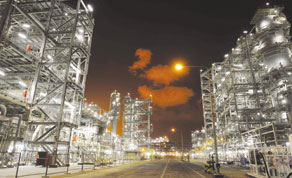
On a coastal site the size of London’s Hyde Park and fed by the world’s biggest non-associated gas field, Pearl, the largest GTL plant on the planet strips methane from wellhead gas and combines it with oxygen to produce diesel, natural gas liquids and ethane.
Voser described Pearl last month as a “one-of-a-kind asset.” Scaled up from Shell’s Bintulu GTL plant in Malaysia, it has a lifetime of 25 years based on an estimated 3bn barrels of oil equivalent (boe) of gas in the North Field that feeds it — a reserve discovered by Shell in 1971.
Shell has paid all the development costs, which amount to around $6 a barrel on that 3bn boe of gas. In return it gets gas supplies from the North Field plus an undisclosed share of the profits Pearl will make.
Shell has said the project would generate $4bn of free cash flow a year at full production in a market with crude oil prices, the main determinant of the price of diesel, at $70 a barrel.
Free cash flow — cash in the bank from sales after subtracting capital spending — is among the purest profit measures.
Shell will say only that returns are in line with other integrated gas projects, but given that Brent crude now sells for over $110 a barrel, while the gas going into Pearl is effectively free, it could clearly be a significant contributor to one of the world’s biggest corporate capital spending budgets — at some $30bn this year alone.
Analysts say crude prices would have to fall below $40 a barrel before the plant loses money.
The Qatari government’s decision to buy a stake in Shell, reported to be approaching 3%, may be further evidence of Pearl’s cash delivery potential.
And the project’s high profile has done no harm to the career of Shell executive Andy Brown, who steered it towards completion from Qatar and then moved into one of the company’s top jobs in The Hague earlier this year as head of international upstream.
Two trains will churn out 140,000 bpd of diesel and other gas-to-liquids fuel products, plus 120,000 barrels of natural gas liquids and ethane. The diesel and liquid fuels output alone amounts to over half of all the non-oil-based road fuels used worldwide in 2010, according to International Energy Agency (IEA) figures.
The water processing part of Pearl alone would service a small city, and steam from the process is recaptured to generate electricity and power the plant’s turbines.
Pearl is Shell’s second major 21st century project in Qatar after Qatargas 4, an LNG export plant, ramped up to full production in 2011.
Shell’s Qatari investments overall will amount to about 10% of its production portfolio at full production. The western world’s second-largest international oil and gas company has now become the largest foreign investor in Qatar.
So is there another Pearl out there? Unlikely, say Shell insiders.
“It’s a pretty unique situation,” one said. “Qatar is mainly an LNG (liquefied natural gas) exporter and was very keen to diversify out of that. Gas reserves on the scale of the North Field combined with that sort of government commitment don’t come around every day.”
Nevertheless, Shell has made clear it is looking at the US, where a glut of gas has forced the price of natural gas to down to levels that make GTL interesting.
Louisiana, Texas or anywhere along the US Gulf coast where there is an existing supply chain are potential sites.
“The longer that the gas price stays low the better the economics look,” the Shell insider said.