AFP/Siem Reap
Southeast Asian nations must redouble efforts to bridge development gaps which threaten the region’s efforts to create an EU-style single market, Cambodia’s prime minister said yesterday.

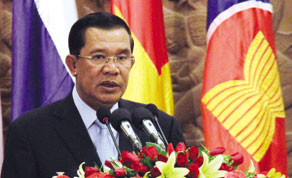
Cambodian Prime Minister Hun Sen speaks during the opening ceremony of the Asean Economic Ministers (AEM) meetings in Siem Reap province, some 300km northwest of Phnom Penh, yesterday
Building an Asean economic community by 2015 is the “top priority”, Hun Sen said as he opened the annual meeting of economic ministers from the Association of Southeast Asian Nations in the Cambodian tourist hub of Siem Reap.
Emulating the European Union’s example, Asean wants to establish a single market and manufacturing base of about 600mn people — a goal that has been spurred by intensifying competition from China and India.
With less than three years to go, Asean must “address challenges and bridge the development gap, which hinders the realisation of (the) Asean Economic Community as planned”, said Hun Sen, according to an official translation.
The development gap among Asean nations “is still huge”, he said. The bloc’s 10 member states range from deeply impoverished Myanmar to advanced city state Singapore and emerging powerhouse Indonesia.
“This requires us to double our efforts to promote further growth and improve equitable distribution of the fruits of growth at both national and regional levels,” Hun Sen said.
In a step towards narrowing the gap between richer and poorer nations and achieving regional integration, the bloc last year set up a nearly $500mn Asean infrastructure fund offering loans to build roads, railways and other projects without direct foreign assistance.
But according to Hun Sen, whose country currently holds the Asean chair, the fund “is still very small”.
He urged the bloc’s economic and finance ministers “to attract more financing partners to increase the fund size” by approaching dialogue partners such as Japan, China, South Korea.
Asean economies grew by 4.7% in 2011, Hun Sen said, despite the weak global economy, high oil prices and volatile capital flows.
The figure was down from 7.6% growth in 2010, according to Asean data.
Despite a slowdown in exports, Asean countries posted a combined trade surplus of more than $90bn in 2011, Hun Sen said.
Asean groups Brunei, Cambodia, Indonesia, Laos, Malaysia, Myanmar, the Philippines, Singapore, Thailand and Vietnam.
During their week-long meeting, the economic ministers will also seek to deepen economic engagement in talks with other nations including China, the US, Russia and India.
The meeting marks the first gathering of Asean members since a foreign ministers’ meeting in July ended in disarray over a maritime dispute in the South China Sea, exposing deep divisions within the bloc.
Meanwhile, in a first by any Canadian official, Trade Minister Ed Fast will visit Myanmar on Sunday on the last stop of a regional tour, his office said. Following official working visits to Vietnam, Thailand and Cambodia, Fast will co-chair the Asean Economic Ministers’ meetings on Friday.
“We continue to pursue deeper ties with the world’s largest, most dynamic and fastest-growing economies, as part of the most ambitious trade expansion plan in Canadian history,” Fast said in a statement.
Asean nations rank as Canada’s seventh-largest trading partner with bilateral trade reaching $15.5bn last year.