


Reuters/London
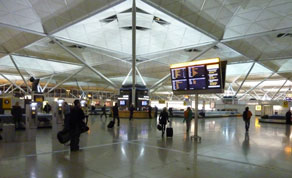
British airports operator BAA opened the way for a $2bn sale of London’s Stansted yesterday with Manchester Airports Group (MAG) an early frontrunner in a bid battle expected to draw US banks, pension funds and Asian operators.

The sale of Stansted is part of a drive by Britain’s competition regulator to loosen BAA’s grip on the UK airports market
BAA yesterday decided against a last-ditch challenge to a regulatory ruling which is forcing it to sell the airport as part of a drive to bring more competition to the market.
Last week, Qatar Holding, the finance arm of the Gulf state’s sovereign wealth fund, took a 20% stake in the operator, underscoring ongoing interest in such assets.
The fund said the UK “remains an attractive investment destination” and other investors are also expected to be drawn by a business that tends to offer stable, long-term cash flows as well as the potential for growth in passenger numbers.
One such investor is Manchester Airports Group (MAG), which has made no secret of its interest in Stansted and has already lined up funding for an expected swoop.
Earlier this month, Australia’s Industry Funds Management (IFM) agreed to buy a 35% stake in MAG if the group wins the battle to buy Stansted.
Banking sources said MAG, which also operates Britain’s Bournemouth and East Midlands airports, is likely to face competition from the infrastructure arms of US banks, as well as investors in and owners of airports in Asia.
A transport banker said South Korea’s Incheon airport authority, which lost out in a bid for Edinburgh airport as part of a JP Morgan-led consortium, was keen on Stansted and that pension funds in the UK and abroad would also look at it.
“The frontrunner here seems to be MAG and its new Australian partner,” said an infrastructure banker seeking a role in the deal who declined to be named.
“Infrastructure funds like JP Morgan Asset Management and Morgan Stanley Infrastructure are very likely to look at it because they have the money and the expertise to run this kind of asset.”
Ferrovial is BAA’s largest shareholder with a 40% stake and heads an ownership consortium made up of Qatar Holding, GIC Special Investments, Alinda Capital Partners and Britannia Airport Partners.
BAA has invited banks including Bank of America Merrill Lynch, Deutsche Bank and Morgan Stanley to pitch ideas on how to handle the sale, the infrastructure banker said.
The sale of Stansted, which handled 18mn passengers last year, is part of a drive by Britain’s competition regulator to loosen BAA’s grip on the UK airports market.
Global Infrastructure Partners (GIP), which bought Scotland’s Edinburgh airport for $1.3bn earlier this year, is unlikely to bid for Stansted because it knows any move would be blocked by regulators.
It also bought Gatwick — Britain’s second busiest airport behind London Heathrow — for £1.5bn in 2009 when the regulator forced BAA to dispose of that site.
The ongoing regulatory crackdown has been a major headache for Ferrovial.
When it bought BAA for £10.3bn in a highly-leveraged deal in 2006, Ferrovial planned to keep all of its airports and make them more efficient by outsourcing services.
Instead, it has been forced to sell assets at a time when valuations are lower than when it bought the business.
BAA currently owns London’s Heathrow, Europe’s busiest airport, as well as Southampton and Stansted in England along with Glasgow and Aberdeen airports in Scotland.
Single runway Stansted, which is predominantly a low-cost leisure and holiday airport, is based 50 kilometres northeast of central London and is the fourth busiest airport in the UK.
Plans for extra runways at Stansted and Heathrow were dropped by BAA after the Conservative-Liberal Democrat coalition came to power in 2010 and the future of the airports is unclear.
“Valuing Stansted is difficult because of uncertainty around what will happen with new runways, which makes it difficult to make a precise valuation. Stansted is also dominated by Easyjet and Ryanair which is bad news for an operator as Ryanair is getting more aggressive,” the transport banker said.
Ryanair has clashed with several airports over the taxes and fees they charge airlines. It recently cut the number of flights to Madrid and Barcelona from the UK in a row over fees.
Some analysts, however, believe Stansted could fetch up to £1.3bn ($2.04bn).
RBC Capital analyst Olivia Peters believes Stansted could potentially be sold for 95% of its regulated asset base (RAB) — around £1.28bn or around 14.2 times its annual earnings before interest, taxes, depreciation and amortisation (Ebitda).
“It seems that there is still substantial interest in UK airport assets as demonstrated by Qatar’s recent purchase of a stake in BAA,” said Peters. “The stake went for a 13% premium to Heathrow’s RAB.”
Ferrovial on Friday sold a 10.6% stake in FGP Topco, the holding company that owns BAA for €607mn to Qatar Holding, a deal giving it an enterprise value (equity plus debt) of 13.7 times Ebitda.
“Stansted’s RAB is about £1.3bn. Gatwick was sold for 90% of its RAB but Stansted is likely to be sold for less, but not much less,” the infrastructure banker said, adding that the sale process would likely start by October and that a deal could happen by the end of the year.
One alternative option is that Ireland’s Ryanair is keen to take a 25% stake in Stansted through a consortium.
Consortia want the airline as an “anchor tenant” to guarantee future growth at the airport, Ryanair Finance Director Howard Millar said recently, adding that the carrier was considering proposals from several groups.