


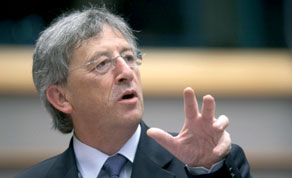
AFP, Reuters/Luxembourg/Athens
Greece will not leave the eurozone, Eurogroup chief Jean-Claude Juncker was quoted as saying yesterday ahead of his talks in Athens, which reportedly may seek more time to implement austerity cuts.

Juncker: ‘A Greek eurozone exit is not part of my working hypothesis
Speaking ahead of a week that will also see Greece’s prime minister meet with the leaders of Germany and France, the head of the eurozone finance ministers group also called current Spanish and Italian bond yields “totally off the mark”.
“No, I don’t think it will happen,” Juncker, who is also Luxembourg’s prime minister, told the Tiroler Tageszeitung Austrian daily when asked whether Greece might leave the troubled currency bloc.
“It won’t happen. If Greece refused budget consolidation and structural reforms outright then we would have to consider this question (of a Greek exit).
“But because I believe that Greece will try to redouble its efforts to meet its targets there is no reason to expect this exit scenario will become relevant,” he told the local paper in an interview.
Juncker is due to meet Greek Prime Minister Antonis Samaras in the Greek capital on Wednesday amid reports that Athens will seek more time to implement the austerity cuts promised in return for two huge bailouts.
Samaras is then due to hold talks with German Chancellor Angela Merkel on Friday in Berlin before he travels to Paris to meet French President Francois Hollande the following day. Merkel and Hollande will meet in Berlin on Thursday.
Greece, having already implemented deep and unpopular spending cuts, needs to find another €11.5bn ($14bn) in savings over 2013-14 as a prerequisite to receiving the next tranche of outside funding needed to keep the economy functioning.
Greek daily Ta Nea on Thursday quoted government sources as saying that Samaras intends to discuss spreading out the cuts but would not make an official request. The Financial Times said he wanted the cuts spread out over four years.
Merkel’s spokesman Steffen Seibert said in Berlin on Wednesday that for the German government “the agreed memorandum of understanding which states what the Greek obligations are remains the basis of all aid decisions.”
“A Greek eurozone exit is not part of my working hypothesis,” Juncker said. “I have said that an exit would be manageable, by which I meant that it would be technically manageable but that it would be politically impracticable.”
“The risks are incalculable. It makes no sense to fantasise in public about exit scenarios,” he said, dismissing as “unnecessary” any contingency planning for Greece becoming the first state to leave the 17-nation eurozone.
A much bigger worry for the eurozone however is whether painfully high current borrowing rates on financial markets for Italy and Spain, the bloc’s third- and fourth-biggest economies, will force Rome and Madrid also to seek bailouts.
“There is no reason to doubt the readiness of Italy and also of Spain to make savings. Both countries have embarked on major cuts, but they are being treated by financial markets as if they were doing nothing,” Juncker said.
“Bond yields of more than 7% are totally off the mark. They do not do justice to the actual situation.”
Meanwhile, finance ministry officials in Greece have calculated that the country’s economy will recover faster and its debt will be more sustainable if it is given two more years to reduce its budget deficit, a Greek newspaper reported yesterday.
Under the terms of its European Union/International Monetary Fund bailout, Greece is bound to implement painful austerity measures to bring its budget deficit below 3% of GDP by the end of 2014, from an expected 9.3% of GDP this year.
But with the country in its fifth consecutive year of recession and social and political discontent rising, Prime Minister Samaras is keen to soften the impact of budget cuts on society by extending the deadline international lenders set it.
The latest estimate, reported by the Imerisia newspaper, cited calculations by finance ministry officials it did not name, saying they had worked out that a two-year extension would help the economy shrink at a slower pace in 2013 and rebound quicker from 2014.
Under such a scenario, the economy would shrink by 1.5% in 2013 and grow by 2% in 2014, the newspaper said. If no extension was granted, the economy would contract by up to 4.5% next year and not recover before 2015, it said.
Greece’s ability to service its debt is seen by its politicians as something that can only be facilitated by growth as its lenders will only continue bankrolling it if it makes all the necessary budget cuts and reform measures to reduce its debt to 120% of GDP by 2020 from 165% in 2013.
But doubts are growing that Athens will hit those targets, prompting calls from some European politicians and policymakers to either eject Greece from the eurozone or to forgive it part of its debts to help it keep the euro.
There is already a clause in Greece’s €130bn ($160.7bn) bailout deal that says the deficit adjustment period could be extended if its recession is deeper than expected.
Greece’s economy contracted at an annual rate of 6.35% in the first half of this year, compared with an EU/IMF forecast for a 4.7% contraction for the full year. Samaras said last month that the economy would shrink by more than 7% in 2012.