


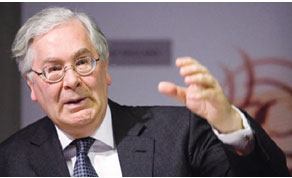
Bloomberg, Reuters/London
Bank of England Governor Mervyn King said the UK must press on with reforms to the banking industry and repeated his gloomy outlook for the euro area debt crisis, which is impeding Britain’s economy.

King: gloomy outlook
“If the rest of the world were growing normally, the re-balancing and recovery of our economy would be much easier,” King wrote in an article in the Mail on Sunday newspaper, published yesterday. “But it isn’t.
“Even the rapidly expanding emerging market economies are slowing, and the problems of the euro area continue with no obvious end in sight.”
King’s comments come days after the Bank of England cut its UK growth forecasts and said the outlook is “unusually uncertain.” The central bank is in the middle of a £50bn ($78bn) four-month programme of bond purchases and has left the door open to more stimulus for the economy if needed.
King, a sports fan who attends the Wimbledon tennis tournament every year, pointed to the success of London’s Olympic Games and said achievements such as winning a gold medal take “years of hard work”.
He said the UK’s long-term economic performance will depend on measures such as “reforming our banking system so that banks focus less on making money in the short term, and more on building businesses to serve their customers.
“The government’s plans to build a wall between banks’ risky trading on one side, and their lending to businesses and families on the other, will help,” King said.
“As will the injection of new competition into our banking system. And, as recent scandals have shown, banks could learn a thing or two about fair play from the Olympic movement.”
The Sunday Times yesterday reported that UK Chancellor of the Exchequer George Osborne will advertise for a new Bank of England governor after several candidates dropped out of the race because of the Libor-rigging scandal.
Remaining candidates have been told that the post will be advertised in the autumn and that they should register official interest then, the newspaper said, citing an unidentified candidate. King is due to retire in June.
King, writing in the Mail, said while the Olympics may boost confidence, they “cannot alter the underlying economic situation we face.
“Unlike the Olympians who have thrilled us, our economy is not at full fitness right now,” King said. “But it is slowly healing. The conditions are in place for a recovery, and the Bank of England is, and will carry on, doing all we can to help bring it about.”
The Bank of England increased its bond-purchase target to £375bn last month in an expansion that will run until November.
It also introduced a programme to boost credit, saying that a “major concern” for policy makers has been an increase in bank funding costs related to the euro-area debt turmoil.
“But if we have learnt anything from the past fortnight, it is that commitment and hard work over a long period are necessary for eventual success,” King said, referring to the Olympics. “Now is the time to start training for the economic marathon - and to follow the example of Team GB.”
King, who has previously criticised banks for excessive pay and shoddy customer treatment, also called for international co-operation to ease a global economic crisis in his column in the Mail.
“As recent scandals have shown, banks could learn a thing or two about fair play from the Olympic movement,” said King, a keen sports fan who is fond of using sporting analogies to clarify economic policy.
In a broader message aimed at policymakers worldwide, he said: “In the midst of the most difficult economic times for several generations, the need for countries to trust each other and work together is more important than ever.
“The origins of the financial crisis were global. So too must be its solution,” he said.
“If we have learnt anything from the past fortnight, it is that commitment and hard work over a long period are necessary for eventual success,” he said.
The reputation of banks is at a low after string of scandals over rate-rigging, mis-selling to customers and high levels of pay at a time when many workers are suffering wage freezes and job insecurity.
Britain’s Barclays bank was fined $453mn in June for manipulating Libor interbank lending rates in a scandal that has embroiled banks on both sides of the Atlantic.
British banks have also set aside billions of pounds to compensate customers mis-sold payment insurance products, and face further costs over the mis-sale of interest rate hedging.
“The financial sector has done us all a disservice in promoting the belief that massive financial compensation is necessary to motivate individuals,” King said.
The thousands of Britons who had volunteered as guides and helpers at the Games showed that “motivation is more than mere money,” he added.