


 |
|
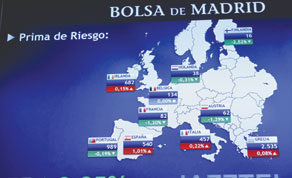
A screen displays a map with the risk premium figures in several European countries on Madrid’s stock exchange yesterday. The Spanish risk premium rose to reach 540 basis points at the opening of the trading day, five basis points more than the figures recorded in the previous trading day, with the 10-year benchmark hovering over the 6.809% |
Economic sentiment in the eurozone fell to near a 3-year low in July as the bloc’s economy deepened its slump and businesses became more pessimistic.
The 2-1/2 year debt crisis that spread from Athens - now struggling to stay in the eurozone — has continued to spread across Europe.
Spain’s recession deepened in the second quarter and economic sentiment in both Germany and France took a hit data showed yesterday. Only non-eurozone member Sweden has upbeat news, reporting accelerating output in the quarter.
Eating away at fragile confidence that was badly damaged by the 2008/2009 financial crisis, Spain’s economy shrank 0.4% from the previous quarter as it fought to overcome a burst housing bubble and to cut its budget deficit dramatically.
Investor concerns about Spain have pushed its funding costs to euro-era highs and the world’s No12 economy risks being pushed towards a full bailout unless it can regain market confidence, in turn hurting business confidence.
“People are asking: what is the future for the eurozone?” said Julian Callow, an economist at Barclays Capital. “All the while, we are searching ourselves and asking what is going to turn this around here. And there are not many answers.”
The mood in businesses across the eurozone fell to a 34-month low in July, near levels last seen after the collapse of US investment bank Lehman Brothers, the European Commission’s sentiment index showed, with morale falling across all sectors.
The index fell to 87.9 points in July from 89.9 in June, worse than economists’ expectations of 88.7 points. Business sentiment fell for the fifth straight month.
European Central Bank President Mario Draghi vowed in London last week to do “whatever it takes to preserve the euro” and this Thursday’s policy meeting will be closely watched. Draghi’s comments have raised hopes high, leading some economists say confidence could take a further hit if the ECB fails to convince markets it is taking effective action.
“The deterioration in economic sentiment adds to evidence that the eurozone is heading deeper into recession,” said Jennifer McKeown at Capital Economics, who sees the 17-nation bloc’s economy contracting 1.5% this year.
The International Monetary Fund is more optimistic, seeing only a 0.3% shrinkage in all of 2012 and a mild recovery next year. Credit rating agency Standard and Poor’s said on Monday it sees a 0.6% contraction this year.
In a sign that the impact of the debt crisis is being felt across the bloc and not just in the indebted south, morale posted its sharpest decline in a year in Germany, the bloc’s biggest economy and largest contributor to the region’s financial bailout funds.
Confidence in the eurozone’s manufacturing sector, crucial to the eurozone’s still relatively healthy export industry, continued its downward trend that started in March as production expectations fell and managers worried about their order books.
The mood also soured in France, the eurozone’s second largest economy. President Francois Hollande is caught between trying to revive growth with major infrastructure projects and European Union rules requiring Paris to bring the budget deficit to below 3% of economic output next year.
A lack of consumer confidence in France and across Europe was highlighted earlier this month by French auto maker PSA Peugeot Citroen’s decision to cut 8,000 jobs as it struggles with weak demand for its vehicles.
“As long as consumer and businesses continue to question the solidity of the monetary union, there’s little hope to see an upturn before long,” said ING economist Peter Vanden Houte.
European Union leaders signed a pact in June to inject €120bn ($145bn) into the economy, including a plan to increase the European Investment Bank’s capital by €10bn so it can raise its lending capacity by €60bn.
While a weaker euro, record low eurozone interest rates and signs of stabilisation in China’s economy could also help revive growth, the lack of confidence remains a major issue.
“Today’s dismal figures only increase the pressure on European policy makers to act decisively to stop the rot in the eurozone,” Vanden Houte said.