


 |
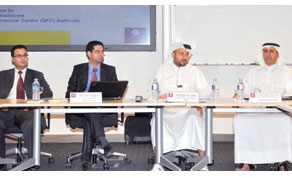
| QFCA and D&B officials at the unveiling of the BOI Q3 rteport |
Weak oil prices as well as the persistent crisis in the eurozone have made Qatar Inc less optimistic in the third quarter (Q3), indicating the cautious approach, according to Business Optimism Index (BOI).
The BOI, jointly prepared by the Qatar Financial Centre Authority (QFCA) and Dun and Bradstreet, saw a weaker outlook for the country’s hydrocarbon sector in view of high level of uncertainty on the oil price amid weaker demand and amble supply.
The respondents were also less optimistic about the non-hydrocarbon sector, primarily due to sharp deterioration in the outlook towards trade and hospitality, manufacturing and finance, realty and business service sectors.
‘The BOI survey for Q3 2012 reveals a drop in optimism levels following the cautious approach adopted by the Qatar’s business community,” Prashant Kumar, senior manager, D&B South Asia Middle East, said.
“It is not a surprise that the overall levels of optimism have fallen given protracted uncertainty in the global economy and the eurozone crisis,” according to Yousuf al-Jaida, QFCA, director of strategic development.
At the same time, in Qatar, growth rates, as expected, are moderating after a six year period of exceptional double digit growth fuelled by ambitious hydro-carbon investments which are now slowing, but GDP growth of 6.9% in the first quarter still remains high by international standards, he added.
The composite score for the hydrocarbon sector stood at 4 points in Q3 against 20 in the previous quarter mainly due to dented outlook towards profits and selling prices.
In the case of the non-hydrocarbon sector, its composite index dropped nine points to 36. “The outlook has moderated probably due to the uncertainty surrounding the global economy and the eurozone crisis,” it said.
Within the non-oil sector, optimism faded in trade and hospitality, finance, real estate and business services and manufacturing sectors, considerably weighed down by demand and profitability parameters.
However, the composite index of construction as well as transport and communication sectors showed upward movement.
Among the issues expected to adversely affect operations in Q3 2012, the overall business environment was ranked as the primary influence on operations by 30% of the respondents. Availability of skilled labour, availability of finance, delay in existing projects and no new projects were cited as a challenge by 6% of the respondents in each category.
The remaining 12% of the respondents have identified other factors including the impact of the global financial meltdown on regional economies through trade and investments, currency fluctuations and uncertainty in the euro region.
However, 40% of the respondents do not anticipate any factors affecting business operations in Q3 2012. A substantial 46% of the respondents plan business expansions in Q3 2012 whereas 32% do not plan any investment, commensurate with this period.
In the oil and gas segment, 38% of the respondents have identified the current business environment in Qatar as a key factor influencing their business operations whereas the same percentage of respondents do not anticipate any negative factors adversely impacting business operations in Q3 2012.
The BOI said 10% of the respondents foresee project delays and lack of new projects as a leading cause of concern in Q3 2012 while 8% expressed concerns relating to the availability of skilled labor.
The remaining 6% of the respondents are concerned about issues including the fluctuation in the exchange rate and uncertain global economic recovery.