


 |
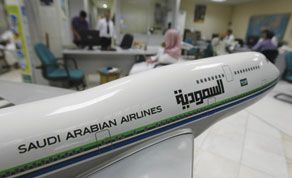
| A model plane stands in an airline ticketing office in Riyadh yesterday. The Saudi decision to open its domestic air travel market to new competition is drawing keen interest from airlines in the Gulf and further afield, and is likely to please customers frustrated by high fares and inconvenient schedules |
Saudi Arabia’s push towards an open skies policy is attracting the interest of major airlines in the Gulf
More than 54mn passengers passed through Saudi Arabia’s 27 airports last year, according to data from the General Authority for Civil Aviation (GACA), rising 13.6% from 2010.
But the kingdom, the biggest Arab economy and the largest country in the Gulf geographically, still has one of the smallest airline networks in the region relative to its size. Saudi Arabian Airlines, the national carrier, and private low-budget carrier National Air Services (NAS) are the only options for flying within the country and they are struggling to keep up with demand.
This is in sharp contrast to neighbours such as the UAE and Qatar, where Emirates airlines and Qatar Airways have made their mark internationally.
“Saudi is a big market with huge distances to cover,” said John Stickland, director of UK-based JLS Consulting. “It’s still moving cautiously but undoubtedly they are looking at what’s happening around them in the Gulf aviation market and realising that it’s not logical to keep a strategy of just supporting the national carrier.”
Licensed foreign carriers for now can only fly in and out of Saudi Arabia not within. Riyadh has announced it would allow new carriers to operate in the kingdom and would grant licenses for the right to operate both local and international flights.
This month, GACA said 14 companies had applied for licences to operate domestic and international flights in the country. Of these, seven have been short-listed and include those fully owned by Saudis, Gulf-Arab firms and consortiums of Saudi-Gulf and Saudi-Chinese companies, the state-run news agency reported. The names of bidders were not revealed but authorities will meet with the short-listed firms in August to talk about the plans.
Most of those seeking a licence are eyeing low-cost flights in the kingdom, where business travel is rising and religious tourism is booming.
“There are several motivations to look at this market, including the amount of business travel and also religious travel that people perform. Despite all that movement the market has no exposure to low-cost travel,” said Stickland.
Qatar Airways has said it wants to launch a new airline based in Saudi Arabia and is keen to invest in the kingdom’s domestic aviation sector.
Sources close to discussions said most bids were from local Saudi firms looking to pick up aviation licences. Firms from neighbouring Bahrain have also shown keen interest.
“We are not applying directly for a licence but we do not rule out working along with partners,” Richard Nuttall, chief executive of Manama-based budget carrier Bahrain Air, told Reuters.
The open skies plan is being welcomed by Saudi residents, worst affected by the limited air network in the country of more than 27mn.
“As a customer I feel I’m stuck with lousy options all the time. Opening the market will force focus and differentiation, competitive prices and packages to win the satisfaction of customers,” said Hasnaa Mokhtar, 35, an executive at a multinational in Jeddah.
Complaints about being booted off flights to make way for VIPs and waiting eight hours in queues for a seat are common in Saudi public forums, including online social media sites.
Residents hope the open-skies policy will bring cheaper travel, better services and more jobs.
“Right now it is more like take it or leave it, their way or the highway, but once they feel the pressure of other airlines offering exceptional service, cheaper prices, more punctual flights, then they will really strive to retain their customers,” Mokhtar said.
The kingdom is investing heavily in aviation infrastructure to back the industry’s expansion plans, including building multibillion dollar projects to expand capacity at the country’s airports, including Riyadh.
Traffic through the capital’s airport, which was originally designed to process 9mn passengers a year, has already reached around 15mn.
The country is also planning a 27bn riyal ($7.2bn) airport in Jeddah, which it will finance through Islamic bonds, or sukuk, to raise its capacity to 30mn passengers annually.
Riyadh is pushing forward with several economic reforms, passing a much-awaited housing mortgage law this month that is expected to stimulate the property market.
It is also discussing opening the stock market to direct investment by foreign institutions.
The Saudi aviation market boom is, however, viewed with scepticism by some who feel more reform is needed to provide a level playing field for all investors.
With a price cap on domestic flights, private airlines have struggled with their profit margins. In 2010 a third carrier, Sama Airlines, was forced to suspend its operations.
“The first experience with Sama and NAS was not successful because it was missing the right policies and procedures as well as fair treatment compared to Saudi Airlines,” Saudi-based economic analyst Abdulwahab Abu Dahesh said.
“Now, under the new procedures, they must show that there is fair and equitable treatment between the carriers and Saudi Airlines. Otherwise the local market will not be competitive and they will face a lot of challenges.”