


 |
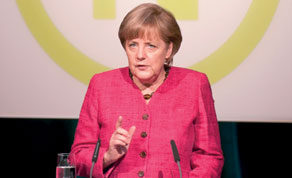
| Merkel speaks at the 12th annual meeting of the German Sustainability Council in Berlin, Germany, yesterday. Merkel dashed any lingering hope in financial markets that Europe would issue common eurozone bonds |
German Chancellor Angela Merkel dashed any lingering hope in financial markets that Europe would issue common eurozone bonds to underpin its single currency after Spain formally became the fourth state to request a financial rescue.
The Spanish government applied for bailout loans yesterday to re-capitalise banks laden with bad debts as the euro and shares fell due to investors’ scepticism that a European Union summit this week will act decisively on the bloc’s debt crisis.
Merkel, who leads Europe’s biggest economy and the main contributor to its rescue funds, said sharing debt liability within the 17-nation euro area would be “economically wrong and counterproductive”.
At a two-day Brussels summit starting on Thursday leaders w ill discuss a cross-border banking union, closer fiscal integration and the possibility of a debt redemption fund, as part of efforts to tackle a worsening debt crisis.
France, Italy and Spain have pushed hard for steps towards mutualising debts and liabilities through a joint bank deposit guarantee, a common bank resolution fund and issuing common eurozone bonds. The conservative German leader adamantly rejects such ideas and is keen to squelch them before the meeting.
“When I think of the summit I feel concerned that yet again we will have too much focus on all kinds of ways of sharing debt,” Merkel told a conference in Berlin.
Critics say that by refusing any such collective solutions, Berlin risks unleashing speculative attacks on Spanish and Italian bonds, hastening rescues which the eurozone’s rescue funds are too small to manage.
Spanish and Italian bond yields rose on Monday as doubts spread that the EU summit would take any decisive action to stem the debilitating crisis, which began in late 2009. The euro fell against the dollar and investors sought shelter in US government debt.
Spanish Economy Minister Luis de Guindos asked for up to €100bn ($125bn) in a letter to Eurogroup chairman Jean-Claude Juncker, saying the final amount of assistance would be set at a later stage.
He confirmed his intention to sign a Memorandum of Understanding for the package by July 9 and said the amount should be enough to cover all banks’ needs, plus an additional security buffer.
The EU’s top economic official, Olli Rehn, said a deal on terms for the loan from Europe’s bailout funds could be concluded within weeks.
“The policy conditionality of the financial assistance, in the form of an EFSF/ESM loan, will be focused on specific reforms targeting the financial sector, including restructuring plans which must fully comply with EU state aid rules,” he said.
The rescue, agreed on June 9, is intended to help Spanish lenders recover from the effects of a burst real estate bubble and a recession, which have piled up bad loans and sinking property portfolios.
Prime Minister Mariano Rajoy told business leaders he would soon take new measures to revive economic growth and create jobs. He said the government remained committed to cutting the public deficit.
Two independent audits last week put the Spanish banks’ capital needs in a severe economic downturn at up to €62bn, and a fuller audit will be delivered in September.
Some market economists believe the rescue is merely a prelude to a full bailout for the Spanish state, which saw its borrowing costs soar to euro era record levels above 7% early last week, although they have eased to below 6.50%.
A working document prepared by top European Union officials calls for the gradual introduction of a banking union, starting with supervisory power for the European Central Bank and developing a deposit guarantee scheme based on pooling national systems, with a levy-funded bank resolution fund.
Berlin has so far rejected any joint deposit guarantee or resolution fund, as well as proposals that eurozone governments should assume joint responsibility for each other’s debts.
Finance Minister Wolfgang Schaeuble hammered home this message in weekend interviews, saying that throwing more money at the crisis would not solve the problems, and telling Greece it must try harder rather than seeking to soften bailout terms.
“We have to fight the causes,” Schaeuble told German TV network ZDF. “Anyone who believes that money alone or bailouts or any other solutions, or monetary policy at the ECB - that will never resolve the problem. The causes have to be resolved.”
He cited Ireland and Portugal as countries that were succeeding in their EU/IMF adjustment programmes and said Greece had not made a sufficient effort.
Merkel and French President Francois Hollande will have one more try at narrowing their differences before the summit on Thursday and Friday.
The two-day EU summit will be the 20th time leaders have met to try to resolve a crisis that has spread across the continent since it began in Greece in early 2010.
The German spokesman said no decisions would be taken on Greece at the summit as the “troika” inspectors from the European Commission, ECB and the International Monetary Fund must first assess Greek compliance with its €130bn bailout agreement before any renegotiation could be considered.
The Samaras government, which was sworn in last week, has called for the re-negotiation of the terms of Greece’s bailout, which is keeping the country from bankruptcy but at the cost of great economic suffering.
Ireland and Portugal have also required sovereign bailouts and the crisis now threatens Spain and Italy. Cyprus, one of the eurozone’s two smallest economies that is heavily exposed to Greece, is also on the brink of needing a rescue.