


 |
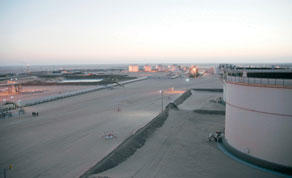
| The handout picture taken on March 15, 2006 shows production facilities of the German oil firm Wintershall in the Libyan desert. Libya plans to spend about $10bn to develop long-term oil and natural gas projects and increase its crude production capacity, Oil Minister Abdul-Rahman Ben Yezza said last week |
Libya is seeking to boost its oil production by a third to 2mn bpd by year-end, surpassing last year’s pre-conflict level, Libyan ambassador to Washington Ali Aujali said.
How fast Libya returns to pre-war levels or surpasses them “depends also on the oil companies, how fast they are returning” to restart or expand operations, Aujali said, speaking at a Bloomberg Government breakfast in Washington on Wednesday.
Beyond oil, Libya is eager for American investment in tourism, healthcare and education, he said. The nation, whose governance is still in flux, plans to hold the first election for the national assembly next month after four decades of rule by dictator Muammar Gaddafi.
“The environment is great” for US companies, in large part because the Obama administration is credited by Libyans with pressing for Nato military action that helped topple Gaddafi last year, Aujali said.
“They appreciate what the Americans did,” he said, and American flags are often flown alongside Libyan ones around the country.
Libya’s governor for Opec, Samir Kamal, set expectations lower than Aujali did, telling reporters last week in Vienna that the government hopes to reach 1.6mn bpd by year-end.
Aujali said the North African nation has restored crude oil production to more than 1.5mn bpd, or 90% of official production figures before Gaddafi was ousted in a violent uprising. The months-long conflict sent production levels plummeting to 45,000 bpd in August, according to a monthly Bloomberg survey of oil companies, producers and analysts.
Libyan production was restored to 1.45mn bpd to 1.55mn bpd by the end of May, according to figures from the Organisation of Petroleum Exporting Countries.
Oil Minister Abdul-Rahman Ben Yezza said last week that Libya plans to spend about $10bn to develop long-term oil and natural gas projects and increase its crude production capacity. He said the country also has a five-year plan to increase production to about 2.2mn bpd.
Aujali said “we need more investment” to develop the oil industry and fulfill a longer-term goal of restoring Libya’s crude production capacity to its historical high. The US Department of Energy estimates it exceeded 3mn bpd in the 1960s.
Aujali cited ConocoPhillips, Exxon Mobil Corp and Occidental Petroleum Corp as among US-based multinational energy giants that have returned to Libya, and urged other US companies to invest in all sectors of Libya’s economy.
American companies need to “be more involved, to be more aggressive to visit Libya to see where they can make business,” he said, so they don’t lose opportunities to other countries such as Italy, which has been proactive in seeking business prospects.
Aujali cited health care, infrastructure, education and tourism as sectors in which the Libyan government is seeking foreign investment. He said tourism remains one of the least-developed industries, citing Libya’s 2,000km (1,243 miles) of beaches and its cultural attractions, including Leptis Magna, one of the best-preserved Roman ruins in the Mediterranean.
Aujali said Libya is seeking American universities and hospitals interested in assisting with training and technology and setting up branches or partnerships, as many have done in the Arabian Gulf and North Africa.
Libya is looking to the US and Nato countries to help rebuild after a bloody conflict that cost the nation billions of dollars in lost trade and revenue, according to the International Monetary Fund. The revolution killed 30,000 people and wounded 50,000 others, according to the Libyan government.
“You supported this revolution at a critical time,” he said. Still, “the new road is not built,” so the US needs to stay involved to ensure the democratic transition is completed.
The Obama administration has done everything possible to assist Libya’s government, including making available $31bn in Libyan government assets under US jurisdiction that was frozen as a penalty on Gaddafi’s government, Aujali said.
The only Libyan assets that remain frozen by the US are about $3bn belonging to the Libyan Investment Authority, the government-managed sovereign wealth fund and holding company based in Tripoli, he said. The authority needs to be reorganised under a dependable board of directors before “we feel safe” asking for the funds to be released, he said.
Libya has scheduled elections for July 7. Aujali said 145 political parties have formed, with 3,000 candidates vying for 200 legislative posts. About 80% of eligible voters have registered, underscoring excitement about the democratic transition, he said.
Still, the situation remains volatile, Mustafa Abdul Jalil, chairman of the National Transitional Council, said in an interview with Qatar News Agency on June 17. Libya risks descending into civil war if the current unstable security situation persists, he was quoted as saying.
Aujali said his country has studied other nations’ models for reconciliation and justice following long dictatorships during which many were persecuted. Libya is “not starting from zero. There are many with experience in the history and we learn from them.”
While some members of the old regime are under arrest, “there is no revenge at the time being against the Gaddafi regime,” he said. “Reconciliation is important. But in the first place, justice has to be made.”