


 |
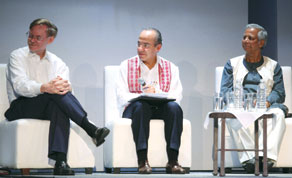
| Mexican President Felipe Calderon (centre) is flanked by World Bank President Zoellick (left) and Grameen Bank President Mohammad Yunus at a conference in Los Cabos, Mexico, ahead of the G20 Summit that started last night |
The head of the Organisation for Economic Co-operation and Development has warned G20 members they may need to deploy “overwhelming force” to confront Europe’s sovereign debt crisis.
Speaking in the Mexican resort of Los Cabos on Saturday night, ahead of the G20 summit of the world’s most powerful economies, OECD Secretary General Angel Gurria said the eurozone’s response to the trouble had not been adequately co-ordinated.
“Europe has the means, the institutions, the vigour and the power ... but its will has not been transmitted in the correct way, because of the problems in the governance of its institutions,” he warned, at a news conference.
The European members of the G20 — Britain, France, Germany and Italy — are expected to come under pressure from all sides during today’s summit to commit to more debt burden-sharing to ease market pressure on Greece and Spain.
Interest rates for the weaker of Europe’s debt-ridden economies have soared amid fears on the bond markets that eurozone members, starting with Greece, might default if stronger powers like Germany fail to back them up.
Gurria said the world faces a “generalised slowdown” and if an institutional response to the problems triggered by the eurozone crisis is not found the G20 might need to deploy “overwhelming force” to contain the fallout.
He said Greece should be given a chance to re-negoiate the terms of its €130bn international bailout if it means keeping the country in the eurozone.
Gurria said if the next Greek government opted to stay in the single currency bloc, it was likely to seek to re-negotiate the terms of the European Union/International Monetary Fund rescue.
“It is a scenario I see (as) likely and if that is the condition presented for Greece to stay and then move on, I would say it is probably something that should be attempted,” he said in an interview ahead of a Group of 20 summit in Mexico.
Greek voters went to the polls yesterday in an election that could determine its future in the euro zone. The left-wing Syriza party says it wants to tear up the terms of the international package, which includes tough austerity measures that have plunged the Greek economy into recession and sparked social unrest.
Earlier on Saturday, German Chancellor Angela Merkel ruled out re-negotiating the bailout saying Greece’s next government should stick to the agreements.
Gurria said Greece’s major political leaders had expressed a desire to stay in the euro area.
“I therefore do not discard there could be some adjustment of the (bailout) conditions to give more time or to put more emphasis on certain of the adjustments than others,” he said.
“If every one of the candidates say they want to stay in the euro, then it’s a different game. A month ago we were saying ‘what if’?” he added.
Meanwhile, outgoing World Bank President Robert Zoellick warned that Europe was facing a “Lehmans moment” and the collapse of the euro currency could trigger a global crisis, in an interview released yesterday.
Zoellick will warn the G20 summit that Europe risks sparking a financial meltdown that would have desperate consequences for developing countries, he told British newspaper The Observer.
“Europe may be able to muddle through but the risk is rising,” the 58-year-old American said.
“There could be a Lehmans moment if things are not properly handled.”
The 2008 collapse of US financial services firm Lehman Brothers — one of Wall Street’s most prestigious firms — after its risky bets on the US housing market soured, sparked global financial panic.