


 |
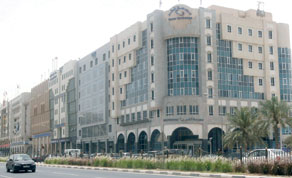
| A general view of the Grand Hamad Street that hosts banks and financial institutions in Doha. Qatar’s banking system operates with loan-to-deposit ratios of above 100%, Standard & Poor’s has said |
Qatari banks were able to issue substantial amounts of long-term bonds in the first quarter of the year despite challenges posed by European banks’ moves to reduce lending to the region, Standard & Poor’s said in the launch edition of its “Middle East Outlook”.
Qatar’s banking system operates with loan-to-deposit ratios of above 100%, the report said. GCC (Gulf Cooperation Council) banks’ access to wholesale banking remains generally healthy, despite the European banking crisis, S&P said.
“That said we believe some of the region’s banks are now less inclined to grow their balance sheets, given some uncertainty about access to wholesale funding and the potential direction of nonperforming loans (NPLs) and loan provisioning.
Regional equity markets have also recovered some ground over the past six months, following trends in global markets, which is positive news for investment companies,” S&P said.
On residential real estate, S&P said, the markets are ‘stabilising” while the office segment remains “weak”.
Across most of the GCC, demand for office space is not enough to absorb new supply, resulting in vacancy rates of 20% and higher in the major capital cities, except in Jeddah and Riyadh, where vacancies are lower.
Dubai’s retail and hospitality sectors continued to perform well throughout 2011, benefiting from declines in Egypt, Bahrain, and other Middle East and North Africa (Mena) markets suffering from social unrest.
“The outlook for retail and hospitality in Abu Dhabi and Doha is more uncertain, owing to likely large supply increases over the coming 2-3 years,” S&P said.
In Bahrain, Manama’s retail and hospitality sectors continue to suffer from weak footfall and occupancy, especially because Saudi visitor numbers are significantly lower than before the unrest began.
Dubai’s residential segment has stabilised in more established locations, such as Downtown, Dubai Marina, Emirates Living, and Palm Jumeirah, but downside remains elsewhere. The Abu Dhabi residential segment remains oversupplied in terms of high-end properties.
The performance of GCC-based telecoms operators, S&P said, should be “broadly stable” in 2012. While the traditional fixed-line voice segment will likely continue to decline, the growth in broadband (both fixed-line and mobile) should more than offset the revenues loss from traditional services.
Competition could also further weaken telecoms players’ profitability, which has remained generally very high compared with levels for their counterparts in mature markets.
“For those players who have established significant international operations, we expect higher growth, as most of the markets where they are active are not yet saturated.
“That said, country risk will likely increase, which might weaken telecoms groups’ business risk profiles in the coming years.”