


 |
|
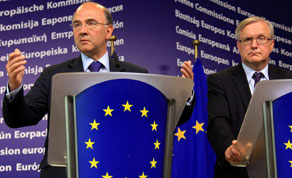
Moscovici (left) gestures during the joint press conference with Rehn yesterday at the EU headquarters in Brussels, Belgium |
European Union leaders should agree to let eurozone rescue funds help struggling banks without national governments having to ask for a bailout first, French Finance Minister Pierre Moscovici said yesterday.
Current rules for the European Stability Mechanism (ESM) — the new euro bailout fund due to be launched in July — state that governments first have to ask for a bailout, and then they can use the money to rescue their banks.
Spain, which is struggling to recapitalise its stricken lender Bankia, has been resisting such a course of action because of the stigma attached to bailout programmes. Cyprus is also facing a possible banking crisis.
Speaking during an impromptu visit to Brussels, Moscovici said letting the ESM intervene directly in support of banks — thus relieving the Spanish government from its embarrassment — was “a fundamental issue on which proposals are on the table.”
“I hope that this will be one of the openings for the future which will be decided” at the next EU summit on June 28-29, Moscovici said during a visit to Brussels.
France is also calling for eurobonds — the joint issuance of eurozone debt — and for the European Central Bank to take bolder action to support the single currency bloc’s economy. Germany is opposed to such proposals.
EU Economy Commissioner Olli Rehn suggested that accommodating French demands on changing ESM rules would take time — with reforms being part of the “banking union” that the European Commission called for last week.
“This is not part of the ESM treaty for the moment, in its present form, but we see that it is important to consider this alternative ... as we are now moving on in the discussion for possible ways and means to create a banking union,” he said.
But Rehn seemed to agree that the issue was critical.
“The key issue is indeed to be able to break the links between the banks and the sovereigns so we can go to the roots of this current debt crisis,” the commissioner said.
Moscovici, meanwhile, said France could meet EU deficit targets without extra austerity measures.
Last month, the European Commission predicted that France’s deficit would reach 4.2% of gross domestic product (GDP) in 2013 — higher than an agreed EU target of 3%.
Moscovici said he travelled to Brussels to “convince” EU partners about the “seriousness, responsibility and credibility” of his government’s plans, “first of all on the subject of public finances.”
Cutting the deficit to 3% of GDP next year, and also achieving budget balance in 2017, “is not only achievable, but it will also be achieved,” he said during a press conference with Rehn.
“We will do it without austerity measures,” the minister told reporters, mentioning a forthcoming corrective budget for 2012 and a multi-annual spending plan for 2013-2015.
Rehn, who last week spoke of “a certain gap” in French public finances and urged Paris to “shortly” adopt “concrete measures,” said he was “very convinced” by Moscovici’s pledges.
But in Paris, a report by the Les Echos financial daily said that an oversight body within the French Finance Ministry had calculated that yearly savings of €3.9bn ($4.9bn) are needed to erase the deficit by 2017.
The report suggested civil service job cuts and salary freezes as options to curtail spending — measures that are at odds with the Socialist government’s campaign promises to hire more teachers and soften a recent pension reform.