


 |
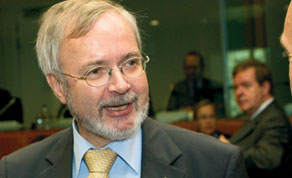
| Hoyer: ‘We must bring the expectations back down to normal proportions ...’ |
Politicians should not foster unrealistic expectations of the European Investment Bank (EIB) if they grant it greater resources to help revive Europe’s economy nor should they pressure it to back specific projects, the bank’s head said.
The European Commission has drawn up a proposal to increase the paid-in capital of the EIB, the EU’s long-term lending arm, one of several schemes aimed at kick-starting growth in the debt-laden bloc which is teetering on the edge of a recession.
The plan — which may be approved by EU leaders at a summit at the end of June — would raise capital by €10bn ($13bn), potentially boosting lending by €60bn and ultimately delivering extra investment of €180bn.
“If we are to raise the volume of our loans then we cannot do this with the current capital base,” the German head of the EIB, Werner Hoyer, said.
“(But) the bank also has to take care that it implements only economically sensible projects and it must not, under political pressure, promote economically pointless projects.”
The EIB must retain the right to refuse backing for project proposals after conducting financial and other checks, he said, adding it was vital the EIB keep its AAA credit rating to be able to continue raising funds at low cost on global markets.
France’s new president, Francois Hollande, has led the calls to strengthen the EIB as part of a wider shift towards boosting growth and jobs amid a growing political backlash across Europe against austerity policies championed by Germany.
Hoyer, who took the EIB’s helm at the start of the year, warned politicians against treating his bank as a panacea for Europe’s ills.
“We must bring the expectations back down to normal proportions ... The EIB is not the solution to the problem but only a part of that solution,” he cautioned.
Even if EU leaders sign off on the plan to boost the EIB’s firepower, the effects will not be felt for some time, Hoyer said, adding that some EU member states would require time-consuming parliamentary approval of any capital increase.
“It takes time to get new projects off the ground and the approval procedures have to be completed,” he said.
“The view that on the day after the summit (of EU leaders in late June) growth rates can move higher is therefore somewhat premature.”
Extra cash for the EIB would fall hardest on its top shareholders. Germany, France, Britain and Italy have pledged about two thirds of its roughly €230bn of callable capital that can be tapped from the EU’s 27 member states.
The EIB must finance itself in the international financial markets and is thus dependent on the trust of investors, hence its warning about political pressure
It took credits worth some €76bn in 2011, almost 50% of that from outside the EU. Now it has at its disposal paid-in capital of around €11bn, and has also built up a reserve fund of €40bn.
Hoyer said the EIB was ready to co-operate with the European Commission on project bonds, another of the plans mooted to revive economic growth, but said selected projects must not compromise the bank’s guidelines.
“It is therefore important that the EIB is involved from the very start by the Commission in the choice of projects. This would prevent the acceptance of riskier projects,” he said.
The project bonds plan envisages EU backing for debt issued by managers of infrastructure projects as a way of attracting investors to finance cross-border transport, energy and communications projects.
The Commission, the EU’s executive arm, aims to launch a pilot project to run over this year and next, using €230mn from the EU budget as collateral and combining with guarantees from the EIB.
Hoyer said the EIB was already actively contributing to stability in the EU’s crisis-ridden southern periphery, including Greece where he said the bank’s credits reached a record €2bn last year.