


 |
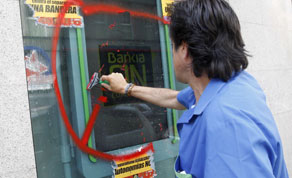
| A man cleans graffiti and banners from a Bankia bank branch in Madrid. Shares in Spain’s fourth-biggest lender Bankia were suspended on the Madrid stock exchange yesterday |
The euro briefly dipped below $1.25 yesterday but European stocks firmed despite dark clouds lingering over the eurozone with concerns that problems at Spanish banks could turn into a full-blown crisis.
Trade was choppy throughout the session but took a final turn higher on news Italian Prime Minister Mario Monti had invited French, Spanish and German leaders to a four-way summit after key Greek elections in June.
At close London’s benchmark FTSE 100 index inched up 0.03% to 5,351.53 points, while Frankfurt’s Dax 30 gained 0.38% to 6,339.94 points and in Paris the CAC 40 rose 0.32% to 3,047.94 points.
Madrid gained 0.13% to 6,543 points even though lender Bankia earlier asked to be suspended from trading on reports saying the bank may seek up to 20bn euros from the state to stay afloat.
On Wall Street, the major US indices were mixed amid thin pre-weekend trade with the Dow Jones down 0.23%, the Nasdaq dipping 0.15% and the S&P index modestly in the black, rising 0.05%.
“The market globally lacked volume and will be sorely short of catalysts over the next few days,” said Renaud Murail of Barclays Bourse in Paris.
In foreign exchange deals, the European single currency, hit $1.2496 during the session touching a low point last seen in July 2010. It later recovered to $1.2514, still lower than $1.2532 late in New York on Thursday.
The dollar firmed to ¥79.64 yen from 79.59.
This week, the single currency has tumbled to a series of multi-month low points on the back of concern over the plight of debt-plagued Greece.
“The euro remains firmly in a downtrend, investors continue to pile into German bunds (bonds) that are returning them next to nothing and Spain’s economy is continuing to be crippled by rising borrowing costs and more bank bailouts,” said Simon Denham, head of Capital Spreads trading group.
“The recipe is a toxic one that shows just how serious the European crisis is becoming and now that we’ve had the big shake out in equities, it would seem that for now at least the selling has been exhausted.”
Across Europe, prices of bonds issued by countries considered to be at less risk from the debt crisis have tended to rise in recent weeks, pushing down their rate of return, as investors seek to put money in safer instruments.
The rate of return earned by holders of French 10-year government bonds touched a record low 2.414% yesterday from 2.531% at the close the previous day.
The yield on French two-year government bonds also fell to a historic low of 0.399%, with five-year bonds at 1.259%.
In Spain, lender Bankia requested the suspension of its shares ahead of a board meeting to decide on a re-capitalisation plan, “in view of the lack of precision on the figures,” the bank said in a statement
The announcement came as a poll yesterday found that consumer confidence in Germany, which has taken a knock from high oil prices in recent months, is currently holding up in face of the eurozone debt crisis.
Market research company GfK said its household confidence index was steady at 5.7 points for June, unchanged from May, a statement said.
On Thursday, the key Ifo business climate index unexpectedly dropped sharply in May, bringing to an end a six-month rally and casting a cloud over the hitherto strong performance of Europe’s biggest economy.
French consumer confidence continued its slow improvement in May but remains below the long-term trend, the INSEE national statistics office said yesterday.
The household sentiment index compiled by INSEE edged up one point to 90, it said, putting it back at levels last seen in late 2010.
In December, the index was at 80, its lowest level since December 2008.