


 |
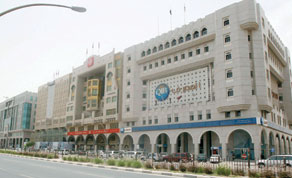
| A general view of the Grand Hamad Street that hosts banks and financial institutions in Doha. Qatar, which is spending billions on developing infrastructure to host the 2022 soccer World Cup, may sell the debt at the end of this month or early June, a banker familiar with the deal has said |
Qatar and Dubai Islamic Bank are planning to tap the Islamic bond market as a scarcity of Shariah-compliant securities and economic growth in the oil-rich region keep benchmark yields near eight-month lows.
Borrowers in the Gulf plan to sell as much as $6bn of dollar-denominated sukuk, which pay asset returns instead of interest, in the next month, data compiled by Bloomberg show. Sales of the debt are already off to a record start of $9.7bn.
Average yields on Islamic bonds in the six-nation Gulf Co-operation Council reached 3.83% on April 27, the lowest since September, the HSBC/Nasdaq Dubai GCC US Dollar Sukuk Index shows.
Investor demand for Shariah-compliant products is growing in an industry whose assets will triple to $2.8tn by 2015, the Kuala Lumpur-based Islamic Financial Services Board estimates. Investment flows into emerging-market bond funds rose to an eight-week high in the week ending May 9, according to US-based research firm EPFR Global.
“Investors are still willing to pay a price premium for new sukuk, which means issuers pay a lower effective yield,” Nick Stadtmiller, head of fixed-income research at Dubai-based Emirates NBD, the UAE’s biggest bank, said by phone May 10. “Eventually, there will be a limit of how much sukuk the market can absorb, but I don’t think we’re close to that limit. Islamic financial institutions still have a lot of cash to deploy.”
Economies in the Middle East, home to more than half of the world’s oil reserves, will expand 4.2% this year and 3.7% in 2013, the International Monetary Fund said in April’s World Economic Outlook report. Advanced economies, which include the US, the euro area, Japan, the UK and Canada, will grow 1.4% in 2012 and 2% next year.
Crude oil has averaged about $103 a barrel so far this year compared with $95 a barrel in 2011.
Qatar, the world’s top exporter of liquefied natural gas may raise about $2bn, a banker said on May 9. The country, which is spending billions on developing infrastructure to host the 2022 soccer World Cup, may sell the debt at the end of this month or early June, a banker familiar with the deal said May 10, declining to be identified because the information is private.
Dubai Islamic, the UAE’s biggest Shariah-compliant lender, hired five banks to sell a benchmark-sized dollar sukuk this month, two bankers familiar with the transaction said May 8.
The difference between the average yield for Gulf sukuk and the London interbank offered rate has declined 33 basis points, or 0.33 percentage points, so far this year to 279 on May 11, according to the HSBC/Nasdaq Dubai GCC US Dollar Sukuk Index. Average yields have dropped 36 basis points in the period to 3.95%.
Gulf sukuk are yielding 43 basis points less than non- Shariah compliant bonds in the region, HSBC/Nasdaq Dubai GCC Conventional US Dollar Bond Index shows.
“Yields will probably not be impacted too much in the short term as there is ample liquidity to absorb the new issuance,” Yaser Abushaban, director of asset management at Emirates Investment Bank in Dubai, said by e-mail on May 10. “However, as more issuance gets done the premium that sukuk command over conventional bonds might erode over time.”
Banque Saudi Fransi, a Saudi Arabian lender part-owned by Credit Agricole, set up a $2bn Islamic bond programme, the bank said in April. Emirates Islamic Bank, the Islamic unit of Emirates NBD, may sell $500mn of Shariah-compliant bonds, Al Khaleej reported on May 7, citing chief executive officer Jamal bin Ghalaita. Islamic Development Bank, a Saudi Arabia-based multilateral lender, plans to sell as much as $1bn in June, its president Ahmad Mohamed Ali said on May 9.
A worsening of the eurozone debt crisis may raise funding costs, EPFR said in a report on Friday.
Still, the “stable buyer base” for sukuk, who typically buy and hold the debt to maturity, will help the securities hold up better than non-Shariah compliant debt in the event of a global sell-off, Stadtmiller said.
Saudi Electricity Co, the state-controlled power producer, received more than $17.5bn in bids for its sale of $1.75bn of Islamic bonds in March. Dubai’s government attracted $4.5bn for its $1.25bn sukuk issue in April.
Qatar’s economy grew 19% in 2011, the fastest in the world, according to International Monetary Fund estimates. While the pace of expansion may slow to 6.1% this year, it will be the highest in the GCC, according to the median forecast of 11 economists compiled by Bloomberg last month. The nation is rated Aa2 at Moody’s Investors Service, its third-highest investment grade. Dubai isn’t rated.
Qatar may spend close to $100bn in “the medium- term” on projects, including the completion of a port and airport, a metro system and roads, the IMF said in January.
The yield on Qatar’s non-Islamic 4.5% bonds maturing January 2022 dropped 37 basis points this year to 3.71% today. The yield on Dubai’s unrated 6.396% Islamic bonds tumbled 165 basis points in the period to 3.93%, narrowing the gap with Malaysia’s 3.928% sukuk due June 2015 to 204 basis points. Malaysia, which is rated A3 at Moody’s, the seventh-highest investment grade, is home to the world’s largest Islamic bond market.
Economic growth in Dubai, which depends heavily on trade, tourism and property, will quicken as much as 5% in 2012 from about 3% last year, the government said in February. Dubai Islamic is rated Baa1 by Moody’s, the third-lowest investment grade.
“The new sukuk issuance is a positive development for the market, especially since it is coming from good issuers,” Abushaban said. “It gives Shariah-compliant investors an opportunity to deploy their funds and it adds depth and liquidity to the sukuk market allowing it to function more normally.”