


Zawya Dow Jones/Dubai
Dubai is scaling back its growth ambitions to reflect a more austere global backdrop as part of revisions to its medium-term development strategy.

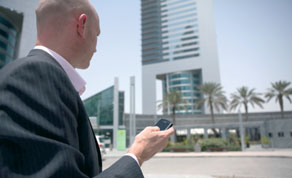
A man uses his mobile phone in front of the Dubai International Finance Centre in Dubai. The emirate’s new development plan would focus on promoting a knowledge-based economy by improving the regulatory environment for financial and professional services industries, attracting international companies to establish headquarters in Dubai and encouraging Dubai-based companies to expand globally
The city-state, which lists the world’s tallest building and man-made islands shaped like palm trees among its achievements, had several such iconic projects in the pipeline as it chalked out an aggressive growth strategy during the boom years.
But it has been made to reassess its plans in the aftermath of a global crisis in 2008 that slowed economic activity in Dubai, forced some of its biggest companies to restructure debt and scuttled its once-vibrant property market.
A revised version of Dubai’s 2015 strategic plan that scraps previous assumptions of double-digit annual economic growth was sent to Dubai’s Executive Council and is expected to be finalised by the end of next month, according to Mohamed Lahouel, the chief economist at the Dubai Department of Economic Development.
The DED is spearheading the revisions, which are to emphasise reinforcing Dubai’s position as a regional hub and growing its knowledge economy.
“We presented it to the Executive Council, but it hasn’t been finalised yet,” Lahouel told Zawya Dow Jones. “This is a continuous process of consultation between the economic department and the council.”
“Hopefully we’ll be able to have the plan at the latest by end of June,” he said.
The Executive Council, a body that oversees government strategy and budgeting, originally commissioned a development plan for the emirate in 2007 that assumed annual 11% real GDP growth, in line with the rapid rate at which Dubai’s economy was expanding at the time.
The Institute of International Finance expects Dubai’s GDP to grow by 2.5% this year, a slowdown from 2011’s estimated 3.2% rate.
The DED has not revealed its new economic growth projections, but the agency has been consulting with companies in the private sector on how the emirate should adjust to lower growth and move forward, according to a person involved in the talks.
“Dubai is captive to the global economy and global sentiment,” the person, who declined to be identified, said. “The economy is outward-looking, and this model served Dubai very well, but it’s not long-term sustainable. In order for Dubai to become an economic revival story its domestic economy needs to develop, maybe through innovation and entrepreneurship.”
The revisions to the 2015 strategy will be based on a review of economic activity in Dubai between 2000 and 2010, according to Dubai’s recently updated prospectus for its $5bn euro medium-term notes program.
The new plan would focus on promoting the emirate’s knowledge-based economy by improving the regulatory environment for financial and professional services industries, attracting international companies to establish headquarters in Dubai and encouraging Dubai-based companies to expand globally, the prospectus says.
This review includes a macroeconomic and microeconomic analysis, including an analysis of the various sectors of Dubai’s economy during this time, as well as the identification of broad economic development trends such as the importance of increased trade relations with emerging Asian economies such as India and China, the prospectus added.
The review would also include the rapid growth in Dubai’s labour force since 2000 and the increased importance of the emirate’s free trade zones, it says.
The original strategic plan laid out aspirations for Dubai’s economic development, social development, security, justice, infrastructure and the public sector.
While the goals would remain largely unchanged, Lahouel said the old plan “had extremely ambitious growth projections and objectives, and for the first years in 2007 and 2008 that worked quite well. Growth in Dubai was not far off the expectations, but then came the international financial crisis and obviously the objectives and policies had to be revised.”