


 |
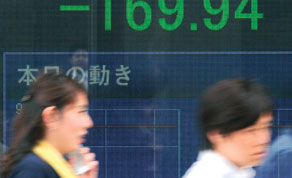
| People walk past an electric quotation board flashing the Nikkei key index of the Tokyo Stock Exchange in front of a securities company in Tokyo, yesterday. Tokyo stocks lost 1.78% to close at their lowest level in nearly 11 weeks yesterday with exporters’ shares dragged down by the yen’s renewed rise against the dollar |
Asia’s benchmark stock index fell, paring Monday’s advance, as Japanese companies forecast lower-than-estimated earnings and as the outlook for exporters dimmed after a report signalled US manufacturing is slowing.
The MSCI Asia Pacific Index lost 0.7% to 124.49 in Tokyo with more than two stocks falling for each that rose. Japan and Australia were the only major markets traded yesterday in Asia, with markets closed in Hong Kong, China, India and South Korea.
“Investors can’t get optimistic about the Japanese economy,” said Koji Toda, chief fund manager at Resona Bank Ltd in Tokyo, a unit of Japan’s fifth-biggest lender by market value. “The number of companies where earnings are improving as much as investors’ expectations is relatively small.”
The Asia-Pacific index fell 2.8% in March and April amid concern Europe will be trapped in a recession with debt- stricken nations such as Spain cut spending, and as Chinese economic growth slows.
Japan’s Nikkei 225 Stock Average fell 1.8% after the yen touched 79.68 per dollar yesterday, matching the strongest level since February 22, showing that the Bank of Japan’s additional stimulus on April 27 isn’t weakening the currency.
A stronger yen cuts the value of overseas earnings at Japanese exporters. Japan’s markets will be closed today and tomorrow for public holidays.
Australia’s S&P/ASX 200 rose 0.8% after the Reserve Bank of Australia yesterday cut its benchmark interest rate by a half percentage point to a two-year-low 3.75%.
Financial shares contributed the most to the gauge’s advance. Commonwealth Bank of Australia added 1.7% to A$52.85. Westpac Banking Corp, Australia’s No. 2 lender by market value, advanced 0.4% to A$22.83. The MSCI Asia Pacific Excluding Japan Index was little changed.
“Aussie equities have been lagging for a while on the tight monetary policy, so it needed to be loosened,”said Nader Naeimi, a Sydney-based strategist at AMP Capital Investors Ltd, which manages almost $100bn.
“Given the weakness that we’ve seen across the board in manufacturing and retail, a quarter-point cut wasn’t going to be enough. They have done the right thing.”
Tokyo Electron, the world’s second-biggest maker of semiconductor production equipment, fell 8.3% to ¥4,085, the lowest level since February 8, after predicting profit will drop 18% this fiscal year.
Yamada Denki, an operator of consumer electronics stores, slumped 10% to 4,665 yen after reporting an operating profit of 88.9bn yen ($1.1bn), missing analyst estimates of 112bn yen.
Sharp Corp, Japan’s largest maker of liquid-crystal displays, dropped 9.3% to ¥468 after forecasting a wider-than-expected full-year net loss.
Of 375 companies listed on the MSCI Asia Pacific Index that have reported earnings since April 10, about 42% missed analysts estimates and 45% beat them.
Companies that do business in the US fell. Sony dropped 3.9% to ¥1,265. Honda Motor, Japan’s second- largest carmaker by market value that generates 44% of its sales in North America, declined 3.4% to 2,799 yen.
“As expectations ratchet up and data can’t support those high expectations, we start to get pessimistic again,” said Andrew Pease, Sydney-based chief investment strategist for the Asia-Pacific region at Russell Investment Group, which manages about $150bn. “Having seen a big rally in stocks in the March quarter, we are back to more neutral positioning. Valuation support isn’t there as strongly as before.”
Stocks also fell after a government report on Monday showed Spain’s economy shrank 0.3% in the first quarter, matching the contraction in the previous three months.
Asian stocks held on to losses even after Chinese government report today showed the Purchasing Managers’ Index rose to 53.3 in April from 53.1 in March.
The MSCI Asia Pacific Index rose 10.1% this year through Monday, compared with an 11.2% gain by the S&P 500 and a 5.2% advance by the Stoxx Europe 600 Index. Stocks in the Asian benchmark are valued at 12.8 times estimated earnings on average, compared with a multiple of 13.3 for the S&P 500 and 10.8 times for the Stoxx 600.
The Nikkei 225 Volatility Index rose 1.4% to 20.81, indicating traders expect a swing of about 6% on the benchmark gauge over the next 30 days. Trading volume on the Nikkei 225 was 6.5% below its 30-day average, according to data compiled by Bloomberg.