


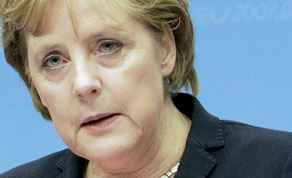
Reuters/Berlin
 |
|
Merkel: ‘No question of re-negotiating a fiscal compact’ |
German Chancellor Angela Merkel added her voice yesterday to calls to bolster the European Investment Bank (EIB) and to use EU infrastructure funds more flexibly to help spur economic growth in Europe.
Her comments are part of a new German emphasis on growth-boosting measures to complement painful tax hikes and spending cuts that have triggered a political and popular backlash against austerity across the eurozone.
The change of rhetoric is also a response to the likelihood that Socialist Francois Hollande will win a French presidential runoff on May 6. Hollande has criticised Merkel’s emphasis on budget cuts and structural reforms.
“I can imagine that we further strengthen the capabilities of the European Investment Bank,” Merkel told the Leipziger Volkszeitung, according to a preview of her interview.
Last week, EU Economic and Monetary Affairs Commissioner Olli Rehn proposed boosting the capital of the EIB, the EU’s investment arm, by €10bn, telling Reuters this would raise the bank’s lending by €60bn and result in a total investment impact of €180bn.
Hollande has also called for a more robust financing role for the EIB and the more efficient use of EU structural funds.
EU finance ministers are due to discuss the EIB issue at their next meeting in mid-May.
Merkel backed a more flexible use of European Union ‘structural funds’ earmarked for infrastructure, training and other areas, saying they could give a boost to small and medium-sized firms.
However, she said there could be no question of re-negotiating a ‘fiscal compact’ on budget discipline agreed by 25 of the EU’s 27 member states last December to include a growth component.
Hollande has rowed back from earlier calls to re-open the ‘compact’ or to seek changes to the mandate of the European Central Bank (ECB), another taboo for Berlin.
Merkel has publicly backed incumbent Nicolas Sarkozy in the French presidential race but said in her newspaper interview she could work well with whoever won the election.
Meanwhile, Bundesbank board member Joachim Nagel outlined the steps the ECB can apply once the eurozone debt crisis has subsided to absorb the excess liquidity it has pumped into financial markets to avert a credit crunch.
Nagel underscored the risks the central bank had taken to fight the debt crisis and reiterated the Bundesbank’s recent calls for the ECB to retighten its lending rules.
“Monetary policy should focus as soon as possible again solely on maintaining price stability,” Nagel said, in a speech prepared for a conference in Munich yesterday.
“I strongly believe, that the stability-oriented fundamental monetary policy of the euro system will not change in future despite the temporary emergency measures due to the crisis.”
The ECB’s balance sheet exceeded €3tn for the first time ever in March after the central bank injected more than 1tn euros into the financial markets with two 3-year lending operations, which helped ease banks’ funding strains.
Nagel said the ECB would raise interest rates should inflationary risk appear, which was currently not the case.
Once markets stabilised, the ECB could withdraw excess cash in a number of different ways, for example by giving banks the option to park money at the ECB for a certain time and a certain return, by raising the minimum reserve ratio, or by issuing central bank bills.
“Central banks will actively make use of such liquidity absorbing tools once markets take up their financing and intermediation function stably again and once central banks’ extraordinary measures are no longer needed,” Nagel said.
He added that central banks’ higher risk provisions to cushion potential fallouts from the ECB’s crisis fighting measures could continue to eat into profits “for a longer period of time”.