


Agencies/Washington
The IMF has called for determined structural reform in Europe to improve the growth aspects in the eurozone, reeling under a public debt crisis.

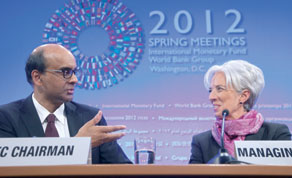
Shanmugaratnam and IMF Managing Director Christine Lagarde converse during a joint press conference
The International Monetary Fund’s steering committee welcomed the authorities’ decisions in March to strengthen European financial firewalls as part of broader reform efforts.
But, echoing comments often heard at the IMF-World Bank spring meetings held in Washington, the International Monetary and Financial Committee stressed that reforms are vital to sustainable growth.
“In the euro area, continued progress on ensuring debt sustainability, securing financial stability, and undertaking bold structural reforms will be crucial to boosting confidence and productivity, facilitating rebalancing within the monetary union, and promoting strong and balanced growth,” the IMFC said in a post-meeting communiqué.
Europe was the main worry at the Washington meetings of finance ministers and central bank chiefs of the sister institutions’ 188 member countries.
On Friday, the IMF and the Group of 20 announced that the eurozone and other countries had committed more than $430bn for an IMF “global firewall” to be used to intervene in crises in Europe or elsewhere.
“The global economy is recovering gradually,” the steering committee said. “But more remains to be done.”
The IMF’s governing panel said the euro area must cut government debt burdens, make bold economic reforms and stabilise its financial systems to restore growth.
Debt problems will resurface unless these steps are taken, the head of the IMF’s governing panel, Singapore Finance Minister Tharman Shanmugaratnam, warned.
“What was really critical in all our minds was to get back to normal growth over the medium term and preferably sooner rather than later, in other words within two to three years,” he said.
“If we don’t get back to normal growth, if we don’t get GDP back to its potential levels, than fiscal sustainability is not possible either,” he warned.
In its policy statement the IMF panel warned against overly harsh budget cuts that could have negative consequences.
“In advanced economies further actions are needed in many countries to achieve credible fiscal consolidation and government debt reduction, while avoiding excessively contractionary fiscal policies,” it said.
The US also piled on pressure. “The success of the next phase of the crisis response will hinge on Europe’s willingness and ability, together with the European Central Bank to apply its tools ... flexibly and aggressively to support countries as they implement reforms,” US Treasury Secretary Timothy Geithner told the IMF’s steering committee.
The committee called upon central banks in advanced economies to retain their accommodative monetary policies, as long as growth remains weak and inflationary expectations under control.
ECB officials resisted pressure at the meetings in Washington to do more to help the eurozone economy, which is at risk of a recession. The IMF last week said the ECB should cut interest rates further from their current level of 1%.
Europe was not the only economy under heightened scrutiny for excessive budget deficits that if left unaddressed could threaten global growth.
“The US and Japan in particular need to tackle their public deficits and debt,” German Finance Minister Wolfgang Schaeuble told his fellow finance ministers.
“This requires a credible medium-term strategy. We understand the political constraints but there is no way around it and there is urgency,” Schaeuble said, echoing the IMF’s recommendations.
Europe, however, presents the most urgent challenge and was the only economy singled out for policy advice by the IMF panel.
Japanese Finance Minister Jun Azumi said strengthening the IMF’s war chest for crisis fighting only buys Europe time. The recent rises in European sovereign debt yields indicate the debt problems continue to pose “considerable” risk to the global economy, he said, as he warned the European policymakers must remain vigilant in their actions.
“Policymakers of individual countries should avoid slipping into complacency and exploit the temporary breathing space that was acquired by the efforts made so far,” Azumi said.
Investors are more concerned about the situation in Europe than elsewhere. Spanish and Italian bonds faced pressure on Friday. The yield on Spain’s 10-year bond topped 6% before retreating..
The IMF committee called on members to ratify “expeditiously” a 2010 plan to increase the representation on emerging economies on the IMF’s executive board to better reflect their growing clout in the world economy. Brazil had pressed this point as essential before it agreed to more IMF funding.
The voting reforms are unlikely to get approved by the IMF’s October meetings unless Washington, facing a bitter presidential election race, can persuade Congress to agree.
“I did not hear any clear announcement from the US that they will be able to deliver before the annual meetings,” Schaeuble said, adding that Europe will have agreed by then.
That would add to tensions between the US, which had insisted upon the reforms, and emerging markets.