


 |
|
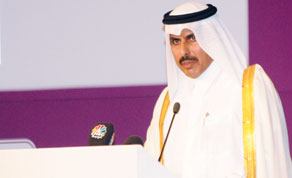
Sheikh Abdullah addressing the conference |
Qatar has sold QR14bn worth treasury bills as of March as part of developing the market for government bonds and facilitate liquidity management, according to the country’s central bank.
“The value of treasury bills reached QR14bn by the end of March 2012,” Qatar Central Bank Governor HE Sheikh Abdullah bin Saud al-Thani told the Bloomberg Doha conference yesterday.
The QCB, following consultations with the government, started offering treasury bills, of various terms, in order to further develop the market of government bonds and facilitate liquidity management, he said.
The government, which plans to sell QR4bn of T-bills a month, paid an average 2% at the last sale in April 3. The treasury bills are aimed at raking in the excess liquidity in the banking sector and set benchmark rates for companies to issue local-currency debt.
By the end of December 2011, treasury bills were listed on the Qatar Exchange in order to allow market participants to trade bonds aiming at facilitating and promoting liquidity management.
The currency policy set by the country aimed at the stability of the exchange rate, considered the pillar of such policy through the maintenance of the Qatari riyal pegged to the dollar, the governor said.
As international investment and business flows are increasingly oriented towards the newly emerged and emerging economies of Asia, South Asia and Africa, Sheikh Abdullah said the Qatar’s and the GCC’s (Gulf Co-operation Council) status as a unique link between the developed economies and these markets will grow in importance.
Although the global economy is currently undergoing a very “sensitive” period as a result of the world financial crisis since the end of 2008, in addition to the economic aftershocks that affected many countries, leading lately to the eurozone crisis and resulting problems, he said “the impact of the crisis on Qatar has been very minimal.”
Highlighting that Qatar has extensive plans to broaden the economy and reduce its dependence on energy as the only source of revenue, Sheikh Abdullah said an essential element of the Qatar National Vision 2030 is a stable and efficient financial system capable of increasing liquidity which can be allocated to the most appropriate projects, and so promote a diversified and modern economy
“A stable and efficient financial sector, therefore, will need to be supported by proper legislation, institutions, and human resources capable of assuming their responsibilities. More importantly it should be supported by political stability which creates a sound environment for the development of the financial sector,” the central bank governor said.
In the area of institutional enhancements, and in order to develop the level of financial services in the country, he said a specialised department dedicated to financial stability was established and has the objective of acting proactively in terms of macro financial and banking risks, in order to enhance the financial system position and to provide it with further strength and stability.
Stressing that a specialised institution dedicated to investors has also been founded for the purpose of keeping securities, in co-operation and co-ordination with the banks working in the country and Qatar Exchange, Sheikh Abdullah said it aimed at creating an enhanced investment environment for both internal and external investors.
“The establishment of this institution is complemented with appropriate legislation, decisions, and instructions, supporting the maintenance of stability which is the central element to attract international investors,” he added.