


 |
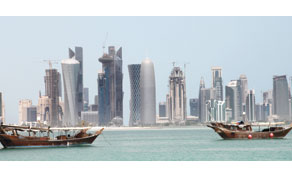
| The West Bay district skyline is seen beyond moored boats in Doha. Qatar’s economic expansion last year of almost 19% was the fastest in the world, International Monetary Fund estimates show |
Qatar and Abu Dhabi’s investment-grade bonds are extending their rally after providing the world’s best returns among similarly-rated notes in the past three years, buoyed by higher oil prices.
The yield on Abu Dhabi’s notes due 2019 fell to a record low on Tuesday, having returned an annual 13% since they were issued in early April 2009, data compiled by Bloomberg show. Qatar’s similar-dated debt earned 12% a year over that period, and the yield dropped to the lowest since September Tuesday. The increase since April 2009 is the most for nations ranked Aa2, the third-highest investment grade, or above by Moody’s Investors Service. Comparable US and German debt handed equivalent annual yields of 7% or less.
The bonds of Qatar and Abu Dhabi, rated Aa2, are rising as crude’s jump to $103 a barrel from $52.50 in April 2009 spurs faster economic growth in the Arabian Gulf. Contracts measuring credit risk for Abu Dhabi, owner of 90% of the UAE’s oil reserves, and Qatar, the world’s top liquefied-natural-gas exporter, fell more than 50% in the past three years.
“Buyers of investment-grade issues were looking at alternatives and Qatar and Abu Dhabi were obvious choices being well-endowed with resources and with lower-debt metrics,” John Bates, the head of fixed-income at Silk Invest, said in an interview on March 28. “Oil prices have been very supportive to producers. Their bonds have been very well supported.”
Qatar’s economic expansion last year of almost 19% was the fastest in the world, International Monetary Fund estimates show. Germany’s GDP grew 2.7% in 2011, the fund estimates.
The UAE, holder of about 7% of the world’s oil reserves and the fifth-biggest producer in the Organisation of Petroleum Exporting Countries, boosted crude output to 2.61mn bpd last month to meet increased demand, according to data compiled by Bloomberg. That is the most production since September 2008.
The country’s gross domestic product is estimated to have expanded more than 3.3% last year, Economy Minister Sultan al-Mansouri said on March 14. Achieving growth of 4% this year depends on oil prices and regional stability, he said. GDP grew 3.2% in 2010, according to the IMF.
The yield on Abu Dhabi’s $1.5bn 6.75% dollar bonds due in 2019 dropped eight basis points, or 0.08 percentage point, this year to 3.21% yesterday, according to data compiled by Bloomberg. The yield on Qatar’s $1bn 6.55% dollar notes declined 20 basis points to 3.48%. It was at 3.47% on Tuesday.
“Yields have been coming down on Qatar and Abu Dhabi bonds because of the healthy balance sheets and economic growth,” said Said Hirsh, a London-based Middle East economist at Capital Economics. “They have been going down as oil prices go higher and balance sheets improve. The other side is that there aren’t many issues in the Middle East so there is a lot of demand when they issue bonds.”
The extra yield on Abu Dhabi’s seven-year debt shrank 27 basis points since December 31 to 149 yesterday, according to data compiled by Bloomberg. The spread on Qatar’s securities declined 43 basis points to 175.
“There isn’t as much juice left in these bonds considering the decline in their spreads and in US Treasury rates since 2009,” said Nick Stadtmiller, the Dubai-based head of fixed income research at Emirates NBD. “Spreads on Abu Dhabi and Qatar are still quite wide relative to other AA credits. But I would expect the spreads to be more stable than other emerging markets in the medium term.”
Qatar is seeking to raise financing for new stadiums and training facilities after being awarded the 2022 World Cup in December 2010, beating out the US, Australia, South Korea and Japan.
The yield on the country’s 4.5% security maturing in January 2022 fell 59 basis points since trading in the notes began late last year to 3.98% yesterday. That outpaced the 32-basis point drop in the average yield for the HSBC/Nasdaq Dubai Middle East Conventional Sovereign US Dollar Bond Index.
Abu Dhabi, the richest and largest of the seven-member UAE, plans to invest $500bn in industrial, tourism and cultural projects to reduce its reliance on oil. The emirate aims to boost non-oil revenue to 64% of the total by 2030, from an average of 41% between 2005 and 2007. The Abu Dhabi Investment Authority is the world’s largest fund with an estimated $627bn in assets, according to the Las Vegas-based Sovereign Wealth Fund Institute.
Qatar’s fund is 12th on SWF’s list with estimated assets of $85bn.
The cost of insuring Abu Dhabi’s debt for five years using credit-default swaps dropped 11 basis points this year to 117 yesterday, taking the past three years’ declines to about 200, according to data provider CMA, which is owned by CME Group Inc and compiles prices quoted by dealers in privately negotiated markets. Qatar’s contracts fell eight basis points this year to 120, compared with 250 three years ago.
“In Europe, many of the investment-grade countries have had problems,” said Michael Cirami, who helps manage $12bn at Boston-based Eaton Vance Corp. “There’s better credit stories in central Europe but they’re in a difficult neighbourhood. Abu Dhabi and Qatar have good balance sheets and strong credit worthiness.”