


 Reuters/Cairo
Egypt’s economic growth will remain relatively anaemic in the coming fiscal year as political uncertainty drags on and the global outlook remains weak, but growth should pick up in the following year, a Reuters poll showed yesterday.
Year-on-year gross domestic product (GDP) will grow by only 1.6% in the financial year starting on July 1, 2012, but will rise to 4% the following year, the survey of 11 economists forecast.
This would still be short of the 6% growth rate that economists say Egypt needs to start creating enough jobs for new entrants to the labour force.
Egypt’s economy has been hammered by a year of turmoil since its popular uprising, which scared away tourists and investors, two of the country’s main sources of foreign exchange, and triggered a series of worker strikes.
Egyptian politics will remain fraught over the next few months, with the first presidential election since Mubarak was ousted scheduled for May and June. Islamists are now the biggest faction in parliament and will have a major say in the drafting of a new constitution in the coming months.
The economy grew only 1.9% in the 2010-11 financial year, weighed down by a 4.6% contraction in the January-March quarter when the revolt forced Hosni Mubarak from the presidency. It grew by only 0.3% year-on-year in July-September, the most recent figure released showed.
The turmoil also led to deficits in both the government budget and the balance of payments that have threatened to tip the country into a full financial crisis.
Egypt, which turned down a financing package from the International Monetary Fund last June, resumed talks in January for a $3.2bn loan, saying it wanted the funds as soon as possible. But the IMF said last week it could take weeks before any agreement is reached.
“While it is possible to argue that Egypt could resolve its twin deficits and even structural problems on the back of a strong global economy, and its high growth rate, as the previous government often did, it will now be harder with a much worse global outlook,” said David Cowan, an economist at Citi.
Tourism, a major source of revenue for Egypt, used to account for over a tenth of GDP before the political turmoil, but its earnings dropped to $8.7bn in calendar 2011 from $12.5bn a year earlier, according to central bank figures.
Net foreign direct investment (FDI) fell to a negative $858.2mn in the fourth quarter of calendar 2011 from a positive $656mn a year earlier.
This helped create a balance of payments deficit of $5.65bn in the politically-fraught final quarter of 2011, compared to a year-earlier surplus of $557mn.
Reserves have tumbled from around $36bon at the start of 2011 to under $15.7bn at the end of February, barely equal to three months worth of imports.
“Some fundamental and very difficult policy decisions have to be made in Egypt in the coming years, which will probably only pay growth dividends a good couple of years down the line,” Cowan said.
Analysts say the new government appointed after the election will have to convince Egyptians to accept a range of unpopular measures to reduce the budget deficit, probably including new taxes and a reduction in energy subsidies.
“Of course, if there are some big changes in the coming months - in particular following presidential elections and an IMF deal - then we could begin to change our views,” said economist Said Hirsh of Capital Economics.
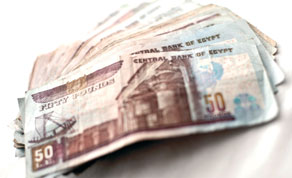
Pressure on the pound is expected to continue. Forecasts suggest it will weaken to an average 6.30 pounds to the US dollar in 2012-13 and 6.75 pounds in 2013-14 from a seven year-low of around 6.03 pounds now.
“We think that some devaluation is necessary given the fact that it is currently overvalued. At the moment, we expect this to happen gradually rather than one big drop, or at least in two or three stages,” Hirsh said.
A big depreciation of the pound would stoke inflation, which is seen accelerating to an average 10% in 2012-13 and the following year.
Inflation was 9.2% in the 12 months to February 2012, down from 10.7% a year earlier.
Unlike other economists in the survey, Hirsh said he believed falling world commodity prices and subdued local demand would keep inflation relatively subdued.