


 |
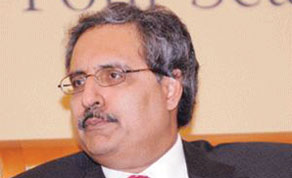
| Shahbaz: ‘... discussions could take around six weeks’ |
Egyptian group EFG Hermes and Qatari Islamic investment bank QInvest are in talks about a possible merger of some operations to create an investment bank covering the Arab world, Africa, Turkey and south and Southeast Asia.
The two financial groups are exploring “a potential strategic alliance” whose aim is to “create a leading investment bank with operations in the Arab world and beyond,” according to a joint statement issued yesterday.
The talks come at a time when the region’s wider financial industry is under pressure to consolidate due to falling profits.
The venture would include securities brokerage, asset management and investment banking operations, but not EFG Hermes Private Equity, the two said yesterday.
The proposed venture could be a boost to both companies, analysts said, with QInvest’s wealth complementing the experience of EFG-Hermes, whose earnings were hit hard by last year’s popular uprising in its home market.
“This makes strategic sense to do and is a win-win situation for both,” said Haissam Arabi, chief executive and fund manager at Gulfmena Investments. “Forming a mega investment bank is also in line with EFG’s plans to become the region’s largest bank.”
EFG Hermes, Egypt’s biggest investment bank, has a market value of $1.08bn and runs offices in nine Arab countries. It also controls a 65% stake in privately-owned Lebanese bank Credit Libanais, which it bought in 2010 for $542mn.
QInvest has a paid-up capital of $750mn and offices in Qatar, Turkey and Saudi Arabia, its website says. Its shareholders include Qatar Islamic Bank, other institutional investors and high net worth individuals.
EFG Hermes shares soared 9.4%, outperforming Egypt’s benchmark index, which closed 1.1% lower.
“It’s probably one of the better consolidation stories that have been announced in the Mena region since the crisis,” said Mohamed Yasin, former chief investment officer at CAPM Investment.
The joint statement by EFG-Hermes and QInvest gave few details on what the proposed investment bank might look like.
The discussions could take around six weeks, the Qatari company’s top executive said yesterday. QInvest however has taken no decision yet on what form a possible tie-up with EFG could take, the company’s chief executive Shahzad Shahbaz said.
He added that the talks could result in a merger, acquisition or just an alliance and he would do whatever “makes sense”.
“A strategic alliance can mean many things: an agreement to work together or it could mean something more than that,” he said, but declined to comment on whether the privately held Doha-based investment bank could take over Cairo-based EFG.
“We cannot comment on anything,” EFG-Hermes’s CEO Hassan Heikal said when contacted by telephone.
Aybek Islamov, a banking analyst with HSBC, said the two banks could generate synergies through cross-selling, client sharing and by relying on each other’s expertise and goodwill in various markets.
“The main question is the amount of capital EFG Hermes will commit to the venture and the returns they can generate on it,” Islamov said.
Analysts said the merger could help QInvest expand its client base outside Qatar, where low trading volumes and operating restrictions have helped slow the brokerage business.
The statement by EFG Hermes and QInvest said the two institutions would assess potential synergies and if they reached an agreement, they would announce a general framework of a joint venture and a timetable for its implementation.
“Our primary objective in these discussions will be to create an investment banking platform that will play a vital role in the flow of foreign capital into the region,” while enabling Arabs to invest in the region as well, the statement quoted EFG Hermes as saying.
Some analysts said the discussions between QInvest and EFG Hermes could spark a further round of consolidation in the region’s financial sector.
“This could set the trend for others to follow and to take advantage of the markets bouncing back,” said Haissam Arabi, chief executive at Gulfmena Alternative Investments.
“This puts competitive pressure on others in terms of forced consolidation, as you don’t want one huge monopoly,” he added.
Though the region’s financial markets have recovered in 2012, the Middle East investment banking industry has been going through a rough patch since the financial crisis of 2008 and the subsequent bursting of the region’s real estate bubble.
Last year, total investment banking net revenues in the region fell to $523mn, from $590mn in 2010, hitting the lowest level since 2005, according to figures from data provider Dealogic.
Regional investment banks Shuaa Capital and Rasmala Investment Bank have scaled back their ambitions, cutting jobs and closing operations.
The discussions with QInvest could allow EFG Hermes to expand its foothold in the Gulf region and gain more business from Qatari investors, while reducing its dependency on Egypt, where the economy has suffered in the wake of the toppling last year of former President Hosni Mubarak.