


 |
|
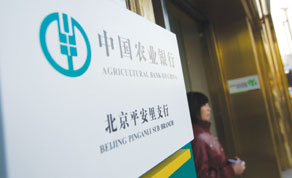
A customer exits an Agricultural Bank of China branch in Beijing. The nation’s third-largest lender has unexpectedly posted its first drop in quarterly profit since its 2010 listing after creating more provisions than analysts had estimated |
Chinese banks misclassified about 20% of their outstanding loans to local governments, understating the risk that slowing revenue will cut borrowers’ ability to repay, a person with knowledge of the matter said.
The China Banking Regulatory Commission told lenders last month that they had incorrectly placed about 1.8tn yuan ($286bn) of loans to local government financing vehicles in the safest category of lending, the person said, declining to be named because the matter is private. The banks erred in calculations and underestimated risks when they decided the loans were fully covered by cash flows from the projects, the person said.
Reclassifying the debts may force banks to set aside greater loan-loss provisions and seek more collateral from regional authorities, whose revenue growth has slumped as the world’s second-biggest economy slows.
Agricultural Bank of China Ltd, the nation’s third-largest lender, on Thursday unexpectedly posted its first drop in quarterly profit since its 2010 listing after creating more provisions than analysts had estimated.
“The impact of a reclassification would not be huge for the entire industry but it can be much bigger for a few banks if the problems are concentrated in them,” said Yvonne Zhang, a Beijing-based vice president and senior analyst at Moody’s Investors Service. “In our stress tests, we assumed that between 20% and 33% of those loans will eventually turn sour without government assistance.”
Local governments in China, prohibited from directly taking out bank loans or selling bonds, have set up more than 6,000 financing companies to raise funds for projects such as stadiums, roads and bridges, the National Audit Office said in a June report.
Regulators and investors have expressed concern that if local-government loans aren’t repaid they could lead to China’s third banking bailout in less than two decades. While the regulator’s warning doesn’t order banks to categorise the loans as non-performing, it suggests that the risks may be greater than lenders have estimated.
About 8.2tn yuan of a total 9tn yuan of loans to the financing vehicles were classified as fully covered by cash flows as of December 31, and some lenders had wrongly included items such as government subsidies in their calculations, the person said. It’s unclear what the regulator will tell banks to do with the misclassified debt, the person said.
The CBRC’s press office responded to a query by referring to a March 1 statement in which the regulator urged lenders to “completely and objectively” recognise risks and problems including maturing of loans to local governments, restructuring of such debt and fluctuation in the value of collateral.
Local government loans that are fully covered by forecast cash flows from the projects they finance should be given a 100% risk weighting when banks calculate their capital adequacy ratios, according to a CBRC regulation released in December 2010. The weighting otherwise would be at least 140% and could be as high as 300%.
Banks need to hold more capital to cover assets with higher risk weightings.