


AFP/Reuters/New Delhi, Washington
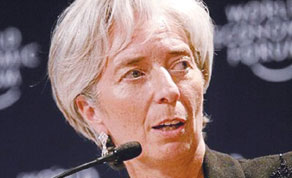
 IMF chief Christine Lagarde said yesterday the global economy has moved back from the “abyss” but that there were still serious weakness in the world financial system.
Lagarde, visiting New Delhi for a two-day trip to attend a conference and meet leaders, said the world financial situation is not as grave as at the start of this year.
“We are further away from the abyss than we were three months ago,” the International Monetary Fund (IMF) managing director told a panel discussion.
Lagarde said steps by the European Central Bank and some European countries had helped stabilise the overall situation but there were still areas “that need to be attacked with vigour”, such as shoring up financial institutions.
“Financial institutions were high contagion agents for this crisis — this tells us where reforms have to focus. Financial institutions have to be agents for growth, not a threat to growth,” she said.
The global financial crisis has been a “huge catalyst” to get political leaders to take politically unpopular measures to restore economic health, she said.
Most European Union nations agreed in January to a treaty that will require governments to introduce laws on balanced budgets and sanctions on countries that violate deficit rules.
“Crisis was a major agent of change but you don’t want to have to go there,” Lagarde said.
For emerging market giant India she said priorities had to be development of its dilapidated ports, airports and other infrastructure in order to remove bottlenecks to economic growth and narrowing its ballooning fiscal deficit.
And she added that export-led China needed to improve its social safety net to spur greater domestic spending and bolster growth.
The Chinese must develop a social welfare system “that does not make them feel they have to save as much as they do so that they consume”, she said.
Meanwhile, US Treasury Secretary Timothy Geithner said Europe was only at the initial stages of a long and difficult path toward fiscal sustainability and warned heavily indebted countries not to resort to draconian measures to fix their budgets, according to congressional testimony released on Monday.
“Economic growth is likely to be weak for some time. The path of fiscal consolidation should be gradual with a multiyear phase-in of reforms,” Geithner said in remarks prepared for delivery to the House Financial Services Committee yesterday.
“If every time economic growth disappoints, governments are forced to cut spending or raise taxes immediately to make up for the impact of weaker growth on deficits, this would risk a self-reinforcing negative spiral of growth-killing austerity,” he said.
The countries at the heart of Europe’s debt crisis — Greece, Ireland, Spain, Italy and Portugal — have each taken steps to reduce their budget deficits and impose reforms to make their countries more competitive. Spain, for example, is overhauling its financial sector and Ireland is re-capitalising its banks.
But Geithner said fiscal reforms were only part of the solution. “For these economic reforms to work, policymakers in the Euro area will have to be careful to calibrate the mix of financial support and the pace of fiscal consolidation,” the Treasury secretary said.
“The reforms will take time and they will not work without financial support that enables governments to borrow at affordable rates and keeps the overall rates of interest across the economy at levels that won’t kill growth,” said Geithner, who has made similar remarks to Republican lawmakers about not slashing the US fiscal deficit at the expense of economic stability and growth.w