


 |
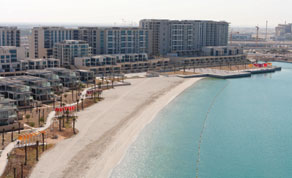
| Residential properties, operated by Aldar, are seen beside a private beach at Al Zeina, part of the Al Raha beach development in Abu Dhabi. Aldar, the biggest in Abu Dhabi by market value, has been hit by slumping prices in the UAE after embarking on a building spree earlier |
Abu Dhabi’s Aldar Properties, rescued twice by the government with bailouts totalling $10bn amid a property slump, may merge with local rival Sorouh Real Estate in a state-backed tie-up, the two firms said yesterday.
A merger of the No 1 and 2 developers in the emirate will create one of the largest property firms in the region by assets with more than 54bn dirhams ($15bn).
The plan comes as property prices slide in the emirate’s real estate sector, which has not recovered from the downturn seen after the 2008 global financial crisis. Property firms in the emirate have been forced to cancel projects and restructure their huge pile of debt.
“We’ll do it if it’s good for both companies,” Sorouh’s managing director Abu Bakr Seddiqi al-Khoury said at the developer’s annual general meeting in Abu Dhabi. “It won’t change or shift our strategy from what we are doing today.”
Any merger decision will be made in the next three months after a joint committee assesses the matter, the companies said in a joint statement on the Abu Dhabi bourse, adding the talks had “the blessing of the Abu Dhabi government.” No further details were provided.
“I think this is targeted not only for Aldar but also for the real estate (market) in Abu Dhabi,” said Ali El Adou, portfolio manager at The National Investor. “The current business set up both for Sorouh and Aldar is not viable in the long run. So the government is trying to create an entity which will have stronger (footing).”
Aldar, which is majority-owned by Abu Dhabi state fund Mubadala and built the Yas Marina Formula One circuit, has relied heavily on the government over the past 18 months.
State investment fund Mubadala has also played a key role in Aldar’s bailout by subscribing to a $2.8bn bond issued by the developer in March 2011. It currently owns 49% of the developer.
Sources told Reuters in January that Abu Dhabi had held talks to offload all or part of the Aldar stake in an attempt to stop its falling asset value from dragging down Mubadala.
“I think it is too early to identify the effect on Mubadala, but this might be an opportunity to exit Aldar or dilute their ownership in it,” said Adou.
Across the oil-rich state, which accounts for more than half of the UAE’s economy, government-backed real estate, commercial and tourism projects, many conceived during the boom years of 2003-2008, are under review and in some cases being delayed or put on hold.
Abu Dhabi pushed back the opening of the much talked about local branches of Louvre and Guggenheim art museums earlier this month.
Aldar, the biggest in Abu Dhabi by market value, has been hit by slumping property prices in the UAE after embarking on a building spree earlier.
The company has assets worth over 40bn dirhams and finally swung to profits in 2011 after repeated losses in 2010, lifted by the government bailout.
Smaller Sorouh, which has assets of 14.1bn dirhams, has fared better than its bigger rival, supported by a focus on existing project completion and delivery.
“The initial reaction has been positive from the shareholders,” Sorouh’s al-Khoury said.
However, both companies have weak balance sheets and this may not be resolved by the merger, analysts said.
“Merging the two companies won’t turn around the dynamics of the Abu Dhabi property market,” said Robert McKinnon, ASAS Capital chief investment officer. “Both companies have fairly weak balance sheets and so merging them isn’t going to solve that problem.”