


 |
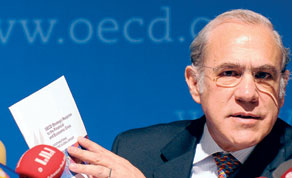
| Gurria: “I think we came here to say: ‘congratulations, job well done. Now get on with it’ |
Germany’s economy is poised to slow almost to a halt this year, the Organisation for Economic Co-operation and Development (OECD) said yesterday, despite Berlin’s “remarkable” crisis management.
Europe’s top economy is forecast to grow by 0.4% this year, the OECD said in its latest report on Germany, before rebounding to expand by 1.9% next year as the turmoil of the eurozone debt crisis begins to calm.
However, the organisation warned of “significant downside risks” to this outlook and its secretary general Angel Gurria told reporters there could be “some periods of even negative growth” ahead.
Gurria said the OECD “recognises the remarkable development of Germany whose growth model has been so successful in navigating through the stormy waters of the crisis.”
“Please accept our sincere congratulations for a well-managed economy,” added Gurria, speaking in Berlin.
The German government itself expects growth of 0.7% this year and has insisted there is no danger of falling into recession for the world’s second-largest exporter after China.
Economy Minister Philipp Roesler said in a statement: “The OECD report underlines that the federal government’s economic policy is exemplary.”
The German economy suffered badly during the 2008 global financial crisis, registering its worst recession in six decades.
But due to multi-billion-euro (dollar) stimulus packages and a scheme allowing workers to reduce their hours while keeping their jobs, Chancellor Angela Merkel managed to keep a lid on unemployment and growth rebounded strongly.
After shrinking by around 5% in 2009, Germany marked record growth of 3.7% in 2010 and continued to expand at a decent clip of 3.0% last year.
German unemployment currently stands at a record low seasonally-adjusted rate of 6.7%.
Moreover, forward-looking indicators have suggested that the German economy will continue to demonstrate resilience to the crisis.
Earlier yesterday, the Zew think-tank’s widely watched barometer of investor confidence shot up to its highest level in 10 months.
German analyst and investor sentiment leapt to its highest level in February since April 2011, smashing expectations and sending the euro to a session high, in a sign that Europe’s bulwark economy is picking up pace again.
The Mannheim-based Zew economic think-tank’s monthly poll of economic sentiment jumped for the third month in a row, rising to 5.4 from -21.6 in January. This was the first time the index turned positive since May.
The data sent the euro to a session high against the dollar and German Bund futures to a session low. A separate Zew gauge of current conditions rose to 40.3 from 28.4, also beating the consensus forecast for a rise to 30.
Nevertheless, the OECD said it was imperative that Germany continue along the path of economic reform, especially given a low potential growth rate and a rapidly ageing population.
“Our main message is that Germany needs to go beyond successful crisis management and address the longer-term underpinnings of growth,” said Gurria.
There are already signs that Germany’s economic motor was starting to splutter towards the end of last year, as demand for its crucial exports began to suffer amid weakening global growth.
Official gross domestic product (GDP) figures for the final quarter of 2011 are expected to be published today.
The national statistics office Destatis has estimated that GDP likely shrank by “around a quarter of a percentage point” in the period from October to December.
To boost annual potential growth in Germany, which the OECD warned could drop as low as one% by 2020, the organisation suggested reforms to the jobs market to get more women in full-time work and plugging skills shortages.
The OECD also urged Berlin to make use of the opportunities in the so-called “green economy”, saying, “in the long term, Germany could become one of the greenest and most energy efficient economies in the world.”
“I think we came here to say: ‘congratulations, job well done. Now get on with it’,” said Gurria.