


 |
|
|
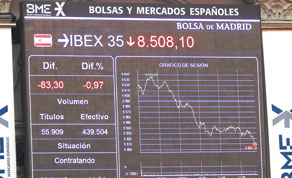
European shares fell to a one-week closing low yesterday on worries about the outcome of debt talks in Greece, while weak earnings news was also a major drag after Ericsson’s results came in below expectations.
Investors were worried an agreement would not be reached in talks between Greece and its private creditors on the debt swap deal needed to avert a default which could cause havoc in financial markets.
There were concerns after the IMF said the European Central Bank may also need to take a haircut if private restructuring is not enough, which traders said could compromise its ability to buy eurozone peripheral debt.
Weak company earnings news also provided a reminder of how the eurozone debt crisis was impacting company growth as tough government austerity measures slowed down spending in the region.
Ericsson dropped 14.1% in volume nearly five times its daily average, leading the fallers list, after its results were impacted by the slowdown in economic activity in the region.
“The market wants to see exactly how the situation in Greece will pan out,” said Mike Lenhoff, chief strategist at Brewin Dolphin Securities. “If this is a stalemate that cannot be broken it could lead to upheaval in the markets.”
“Earnings have not been good, estimates are being revised downwards and are a reflection of what is going on in Europe. We are defensive as the outlook is cloudy.
Ericsson’s earnings news followed on from disappointing results from German conglomerate Siemens on Tuesday, which also continued its slide from the previous session, down 5%, after several brokers lowered their views on the firm.
Siemens, a bellwether for Europe’s manufacturing industry, was in the worst performers’ list for the second day running and volume was strong at 131.7% of its 90-day daily average.
The pan-European FTSEurofirst 300 index of top shares closed down 0.5% at 1,039.64 points.
After the market close, the US Federal Reserve said it would not raise interest rates until at least late-2014 to help bolster economic growth. The US S&P 500 turned
positive after the news.
The Fed, after a two-day policy meeting, repeated its view that the economy faces “significant downside risks” but it offered little to suggest it was close to launching another round of bond-buying to prop up growth.
It did say, however, that it would maintain a “highly accommodative” monetary policy stance. Economic conditions “are likely to warrant exceptionally low levels for the federal funds rate at least through late 2014,” the central bank said in a statement.
The central bank also appeared more sanguine on the inflation outlook, suggesting prices were now rising at a pace consistent with policymakers’ goals. The statement also dropped a reference saying the Fed was monitoring inflation and inflation expectations.
The FTSEurofirst 300 index’s next resistance level was seen at around 1,062 points – its 61.8% Fibonacci Retracement from its February 2011 to September sell-off.
London’s FTSE 100 index of leading shares dropping 0.50% to 5,723points.
In Paris, the CAC-40 index fell by 0.31% to 3,312.48 points while in Frankfurt the Dax 30 bucked the trend to end the day up by 0.04% at 6,421.85 points
Only 5% of companies on the Stoxx Europe 600 have reported results. Out of these 39% have either beat or met expectations, while 62% have missed, according to Thomson Reuters Starmine data.