


 |
|
|
Oman plans to boost budget spending by 26% in its five-year plan, which ends in 2015, to create jobs and improve living standards in the Gulf Arab oil exporter, its finance minister said yesterday.
The sultanate has planned to spend 43bn rials ($112bn) over five years.
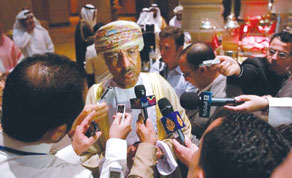
However, Finance Minister Darwish al-Balushi told Reuters that the government has now decided to increase the planned amount to 54bn rials to cover “additional obligations”.
“It is the government’s response to the social requirements such as providing jobs, social security and unemployment benefits,” Balushi said.
Oman’s five-year spending plans are usually evenly distributed, but it is not specified how much money will be injected into its oil-reliant economy each year. He did not say how the 2012 budget would be affected by the increase.
A finance ministry official, who did not want to be named, told Reuters the ministry was targeting an average budget growth of 7% a year in the next four years to 2015.
He declined to provide yearly plans, saying those would depend on oil production and prices.
Sultan Qaboos bin Said, who has ruled Oman for 40 years, promised $2.6bn in additional spending in April and announced plans to create 50,000 new jobs.
In September, Balushi told Reuters government spending should rise to 9.2bn rials in 2011 from the initially planned 8.1bn following the social measures.
In November, the consultative Shura Council approved the 2012 budget draft, estimating expenditures of 10bn rials and revenue of 8.8bn. State news agency ONA said earlier this month that Sultan Qaboos had signed the budget.
Oman forecast a fiscal deficit of 5.4% of 2010 gross domestic product in its 2012 budget, according to Reuters calculations based on an average oil price of $75 a barrel.
Its wealthier Gulf Arab neighbours pledged in March to provide $10bn in aid over 10 years to help the country address its social challenges. Government officials have said the first tranche was expected to arrive this year.
Analysts polled by Reuters in December expected the non-Opec oil producer to post a fiscal surplus of 4.7% of GDP in 2012, after an estimated 6.7% in 2011, thanks to robust crude prices.
The government said in December it created 35,000 jobs in 2011 and pledged another 35,000 jobs for this year.
Analysts said Oman, whose debt to GDP is forecast by the IMF to be the lowest in the Gulf at 3.2% this year, will have no problem to meet the extra financial demands due to strong oil prices and higher crude production.
“Oman is now producing nearly 900,000 bpd from 820,000 bpd this time last year. My estimate is that it will achieve an average of $105 per barrel for its oil sales in 2011, and that is almost double from what it has based its 2011 budget on,” said Khalid al-Saidi, analyst at Al Omaniya Financial Services Co.
The IMF projected that the minimum oil price which Oman needs to balance its budget will rise from $81 per barrel in 2012 to $105 by 2016. A Reuters poll in December forecast Brent crude prices to average $106 per barrel in 2012.