


Bloomberg/Dubai/London
European banks, led by those from France and Belgium, are seeking to sell Gulf loan books to Arab banks to help raise cash as the sovereign-debt crisis drags on, bankers familiar with the offerings said.

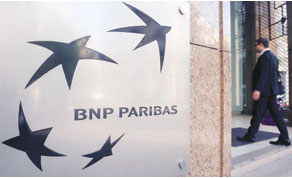
A pedestrian enters the headquarters of BNP Paribas in Paris. France’s BNP Paribas and Societe Generale, Belgium-based Dexia and KBC Groep, and Intesa Sanpaolo and UniCredit of Italy are said to be among lenders seeking buyers for project finance and corporate loans in the Middle East
France’s BNP Paribas and Societe Generale, Belgium-based Dexia and KBC Groep, and Italy’s Intesa Sanpaolo and UniCredit are among lenders seeking buyers for project finance and corporate loans in the region, five bankers who were approached with deals said, declining to be identified because the information is private. The offers were made over the past six months, they said.
Europe’s banks are curtailing some types of lending and selling businesses to meet regulators’ demands for higher capital as the debt crisis worsens.
Banks across Europe have pledged to cut more than €950bn ($1.2tn) of assets over the next two years, according to data compiled by Bloomberg.
“There have been some large transactions in recent months,” Ahmad Alanani, the Dubai-based director for the Middle East at investment bank Exotix, which trades debt, said in a phone interview. “Cash rich banks from Qatar, Abu Dhabi and even some banks from Kuwait are natural buyers of these assets.”
BNP Paribas, Societe Generale, Unicredit and Intesa spokespersons declined to comment, while Dexia didn’t immediately respond to a request for comment.
“International project finance is one of the activities that are gradually being wound down at KBC,” Stef Leunens, a spokesman for KBC Groep in Brussels, said in an e-mail. “It’s logical that we get expressions of interest for some of the run- off parts of this portfolio from time to time.”
Qatar, Abu Dhabi and Kuwait, among the biggest oil producers in the world, are spending billions of dollars to build homes, infrastructure and energy facilities to diversify their economies and create jobs. These countries have also been spared the political unrest that has swept through the Middle East and toppled rulers in Tunisia, Egypt and Libya.
“A lot of these European banks are selling their premium assets to realise higher recoveries and generate some liquidity,” Alanani said. “We see a large offering of Middle East project finance portfolios as the cost of dollar funding has increased making these long-term assets less attractive.”
European continental banks, especially the French lenders, are seeking to reduce their US dollar funding needs after access to the US money-market dried up. The eight largest prime US money market mutual funds have slashed their holdings of French bank debt by $76.8bn in the past 12 months. They cut them by 68% in November alone.
Borrowing costs for European banks have climbed as European governments struggled to contain the sovereign-debt crisis, with the three-month London interbank offered rate, or Libor, jumping 33 basis points from a low of 0.245% on June 15 to an annual high of 0.579% on December 28.
European banks have more than €1.7tn of non-core and non-performing assets on their balance sheets, according to Deloitte LLP.
Three of the bankers said they didn’t find the discounts offered on loans they had seen as sufficiently attractive. The loans offered a net interest margin, a measure of profitability, of 0.7% to 0.8%, less than the 1.5% to 2% they are seeking, said one of the bankers, who declined to identify which lender had offered the loans. Discounts may increase next year as the pressure grows on the European banks to free cash and raise capital, the bankers said.
European regulators have asked their banks to boost core capital to 9% by the end of June. Most are reluctant to raise equity because their share prices are too low.
In the Middle East and North Africa, banks have arranged $32bn in syndicated loans this year, about half the $61bn raised in 2010 and less than a third of the 2007 peak of $109.2bn. European banks arranged about 42% of the loans this year compared with about 39% in 2010.
Half of the top 10 mandated banks this year are lenders based in the Arab world, such as National Bank of Egypt, up from three in 2010 and 2009, according to data compiled by Bloomberg.
Banks in the Gulf region are recovering from the global credit crisis, which slowed lending and hurt investment banking. Institutions in Qatar, Abu Dhabi and Saudi Arabia are seeking to boost lending to support government spending to diversify their economies.