Zawya Dow Jones/Riyadh
Strong oil prices and some of the highest stated crude output levels in Saudi Arabia in decades are expected to give the kingdom a budget surplus of as much as 288bn Saudi riyals ($77bn) in 2012, more than enough to fund the country’s ongoing massive public-spending projects, analysts said ahead of the budget’s release later this month.

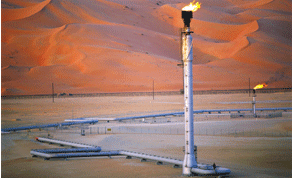
A view of the Shaybah oilfield development in Saudi Arabia’s Al-Rub Al-Khali desert, some 800km southeast of the eastern Dhahran (file photo). At current Saudi spending levels, the kingdom breaks even when prices are around $75 a barrel, according to analyst estimates
Saudi Arabia launched more than $130bn in projects related to jobs, housing and other public benefits since early 2011, the beginning of public uprisings elsewhere in the Arab world. The 2012 budget surplus is expected to be in the range of 190bn riyals to 288bn riyals, analysts estimate, enabling the government to press ahead with its social spending drive.
Paul Gamble, head of research at Jadwa Investments in Riyadh, is projecting a sizeable 288bn riyals budget surplus, below the high of 580bn riyals in 2008, when global oil prices peaked around $145 a barrel. The figure is in line with the surplus projected by Saudi’s central bank, while some other analysts’ projections of the surplus run more conservatively, at 185bn riyals or less.
Saudi Arabia, the Middle East’s biggest economy, is flush from a rebound in oil prices, which have climbed back up to a year average of $110 a barrel for North Sea benchmark Brent crude. At current Saudi spending levels, the kingdom breaks even when prices are around $75 a barrel, according to analyst estimates. Additionally, Saudi oil minister Ali Naimi announced earlier this month that Saudi had stepped up crude production to more than 10mn bpd.
With the expected surplus, and net foreign assets that topped $500bn in late October, according to central bank data, Saudi authorities have “huge scope to carry on spending very aggressively, because they can,” Gamble said.
The government is expected in 2012 to keep making a “big push in terms of education, housing, healthcare,” said Farouk Miah, equity analyst with Saudi-based NCB Capital.
He said construction-related stocks are following the pattern of recent years of increasing 10% to 15% in the weeks ahead of the budget release in anticipation of continued strong government spending on infrastructure.
Saudi Arabia’s announced budget for 2011 was 580bn riyals, although spending for the year appears to have run about one-fifth higher, at more than 800bn riyals, Jadwa’s Gamble said. In absolute terms, spending is expected to be lower in 2012, with education, healthcare and defense, which is estimated to take up almost a third of the budget, among the chief expenditures, he said. It is not clear whether the government will outlay more large sums on housing next year, he added.
Despite the healthy surpluses, analysts widely predict Saudi Arabia to begin having funding trouble in coming years if domestic oil consumption, now increasing at almost 5% a year, and public spending keep up their rapid growth.
“It does really point to a squeeze somewhere down the road,” with a deficit by perhaps 2014, Gamble said.