Reuters/Dubai
Dubai, which narrowly averted a bond default in 2009, could use money raised by its sovereign wealth fund to help repay $3.8bn in bonds owed by state-linked firms which mature next year, a source familiar with the matter said yesterday.

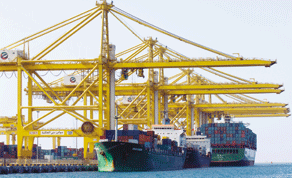
Container ships sitting at Jebel Ali Port in Dubai (file photo). The Gulf emirate has clawed its way back from the depths of its debt crisis, helped by an economic revival in trade and tourism and its safe-haven status amid the Arab Spring revolts, but still faces the challenge of big debt repayments
The Gulf Arab emirate has clawed its way back from the depths of its debt crisis, helped by an economic revival in trade and tourism and its safe-haven status amid the Arab Spring revolts, but still faces the challenge of big debt repayments.
The Financial Times reported earlier yesterday that Dubai had raised the prospect of restructuring some bonds, a move some observers characterised as a trial balloon by the authorities to gauge creditors’ pain thresholds.
Discussions in government circles focus on $3.8bn in bonds due next year from a trio of state-linked firms seen as having the highest refinancing risk, a source said.
Those firms are Dubai Holding Commercial Operations Group (DHCOG), part of the ruler’s private holding company, DIFC Investments (DIFCI) and Jebel Ali Free Zone (JAFZA).
The Investment Corp of Dubai (ICD), the emirate’s sovereign wealth arm, may be involved.
The fund is run by Mohamed al-Shaibani, who was tasked with resolving Dubai’s debt mess after the 2008 property crash and global credit crunch.
“All options are still on the table for the bonds. Could be refinanced, could be paid back by ICD partially,” the source said, speaking on condition of anonymity. “ICD would use funds that it raised (recently).”
“It has raised $1.5bn in bilateral loans and is aiming for $2bn, it’s mostly from local banks.”
The restructuring talk brought quick reactions from two of the three parties in focus.
Dubai Holding Commercial Operations Group said in a statement that it would repay its $500mn bond in full and on time next February from its own internal resources and had no plans to restructure future loan obligations.
JAFZA is confident it can refinance a $2.04bn Islamic bond due next year without government support and it does not rule out asset sales to help raise funds, its chairman said yesterday.
Hisham Abdullah al-Shirawi told Reuters on the sidelines of a business forum that the Dubai World unit was in talks with “many financial institutions and others” to refinance the dirham-denominated Islamic bond, or sukuk, due in November 2012.
The JAFZA issue has been flagged by rating agencies Moody’s and Standard & Poor’s as among the most problematic of Dubai’s repayments due next year.
The sukuk is not guaranteed by the government of Dubai and bondholders are predominately local banks. Al-Shirawi said the majority of bondholders have been informed of the refinancing but declined to give further details.
ICD holds about $70bn in assets and its financial position is bolstered by dividend payouts from its portfolio of companies. Its investments include successful airline Emirates, bank Emirates NBD and Dubai Islamic Bank
A government official suggested that all paths were being considered including a restructuring. “As you know, the Dubai government has previously paid some (debt) and refinanced some and it might be the same again,” he said, on condition of anonymity.
The FT quoted a senior government official as saying the emirate is pursuing other options to help state-related entities meet their obligations, including raising $2bn in funds from liquid local banks, the newspaper said.
“We are working hard to meet all our liabilities but times are different. We are more confident we can negotiate a commercial deal with bondholders,” the official was quoted as saying in the article.
Sources said that some bonds may be repaid while others replaced by new, longer maturities.
Dubai has negotiated terms to restructure some $41bn of debt related to its flagship conglomerate Dubai World and its property arm Nakheel, and other state-linked firms have been refinancing loans over the past two years.
But it has been careful to pay bondholders in full upon maturity and restructuring such issues would be a departure, possibly signalling the depleted resources left in its financial support fund for Dubai Inc, as the matrix of state-linked firms are known.
“Dubai has put a substantial amount of effort into restoring its credibility,” said Chavan Bhogaita, head of markets strategy unit at National Bank of Abu Dhabi. “’Restructuring’ high profile bonds from the likes of Jafz, DIFCI and DHCOG would simply undermine all these efforts and possibly take us back to late 2009, early 2010-type sentiment. In our view, it doesn’t make sense to do this.”
In December 2009, Abu Dhabi stepped in with a last-minute lifeline to help Dubai avert an embarrassing default on a Nakheel Islamic bond. It subsequently paid off Nakheel’s 2010 and 2011 bonds in full upon maturity.
Dubai stunned global markets in November 2009 when it sought a standstill on $26bn in debts related to Dubai World. It struck a deal with banks last year, promising full repayment on the principal in five to eight years.
All three major bond maturities due next year trade at a deep discount to par, suggesting investors place a massive premium on the bonds to reflect the potential risks associated with timely and full repayment.
“We believe it is DIFCI that is most likely to rely on direct government support in conjunction with refinancing its maturing debt obligations in 2012,” ratings agency Moody’s said yesterday, noting the Dubai government is directly exposed to DIFCI, which runs the city’s financial freezone, having given it two loans.
UAE banks face fresh troubles: Fitch
Banks in the UAE face new headwinds due to a weakening global economy and Abu Dhabi’s move to scale back spending and delay construction projects, Fitch Ratings said yesterday.
In a report, Fitch said the global slowdown will affect key sectors such as trade, tourism and services while a fragile real estate sector and problems at Dubai state-linked firms and other companies “pose significant asset quality challenges”.
The ratings agency also cited the short-term impact of slowing projects in the emirate of Abu Dhabi which has taken a tough line on budget spending and jettisoned non-core infrastructure plans, such as building local branches of the Guggenheim and Louvre museums.
Across the oil-exporting emirate, which accounts for more than half of the UAE’ economy, government-backed real estate, commercial and tourism projects, many conceived during the boom years of 2003-2008, are under review and in some cases being delayed or put on hold.
“This sharper-than-anticipated slowdown in the construction sector in Abu Dhabi could have some implications for the banks’ asset quality in the short-term,” it said.
Fitch said that UAE banks remain profitable, despite slower loan growth and weaker asset quality. It said a key challenge would be their ability to raise long-term funding.
“Fitch anticipates core earnings will decline given low business volumes and the recent Central Bank of the UAE rules on retail banking.”
The central bank capped the amount commercial banks can lend to individuals at 20 times their salary and set the period for loan repayment at 48 months this year to prevent excesses seen during the oil boom years of 2007-2008.