


 |
|
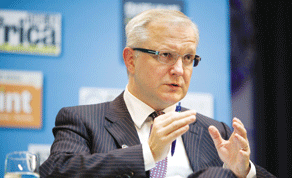
Rehn: ‘One simply cannot build a growth strategy on accumulating more debt ...’ |
Spain’s Socialists became the fifth government in the 17-nation single currency area to be toppled by the sovereign debt crisis this year. Portugal, Ireland, Italy and Greece went before while Slovakia’s cabinet lost a confidence vote last month and faces a general election in March.
An absolute parliamentary majority for Mariano Rajoy’s centre-right Popular Party brought no respite on financial markets increasingly alarmed by the absence of an effective firewall to halt a meltdown on sovereign bond markets.
The risk premiums on Spanish, Italian, French and Belgian government bonds rose as investors fled to safe-haven German Bunds, while European shares fell more than 2% after Moody’s warned that France’s credit rating faced new dangers.
“This crisis is hitting the core of the eurozone. We should have no illusions about this,” European Economic and Monetary Affairs Commissioner Olli Rehn said.
He defended the European Union executive’s advocacy of austerity policies blamed for choking off growth and jobs.
“One simply cannot build a growth strategy on accumulating more debt, when the capacity to service the current debt is questioned by the markets,” Rehn told a Brussels seminar. “One cannot force foreign creditors to lend more money, if they don’t have the confidence to do it.”
In Greece, the starting point of turmoil now felt around the world, more political wrangling cast a pall over the new technocrat prime minister’s bid to win the nod from European leaders for bailout funds to avert bankruptcy.
Borrowing costs for both Spain and Italy hit levels regarded as unsustainable last week before the European Central Bank stepped in to steady the market.
Two newspapers said the ECB’s governing council had imposed a weekly limit of €20bn on purchases of eurozone government bonds, a figure analysts say prevents it wielding massive deterrent power in the markets. Germany’s central bank has led resistance to the bond-buying it sees as inflationary.
The latest weekly figures released yesterday showed the central bank bought nearly €8bn in the week to last Wednesday, far below that reported limit in a week when Italian and French spreads hit euro era highs.
ECB governing council member Ewald Nowotny, regarded as a dove, told a conference in Vienna that the central bank could not simply start printing money but would have to discuss its next response to the crisis.
“What we certainly have to discuss is what is a role for the ECB in these difficult times, but this is also something we will discuss in Frankfurt at the appropriate time,” he said.
Ratings agency Moody’s said a recent rise in interest rates on French government debt and weaker economic growth prospects could be negative for France’s credit rating.
“Elevated borrowing costs persisting for an extended period would amplify the fiscal challenges the French government faces amid a deteriorating growth outlook, with negative credit implications,” Senior Credit Officer Alexander Kockerbeck said in Moody’s Weekly Credit Outlook yesterday.
France’s government spokeswoman reaffirmed yesterday that Paris would not impose a third package of budget savings, despite market pressure on its cost of credit.
Talk of a possible break-up of the 12-year-old single currency has grown among analysts, mostly outside the euro area, as EU paymaster Germany has rejected most of the widely-touted solutions to the debt crisis.
The chairman of Goldman Sachs Asset Management, Jim O’Neill, said the crisis of European economic and monetary union (EMU) meant “big decisions have to be taken pretty quickly”.
“It’s not obvious to me that EMU could survive without Italy,” he told a Confederation of British Industry conference.
“It’s not obvious to me that Italy can survive with 6-7% bond yields, so something’s going to have give pretty quickly. Italian bond yields have got to come down pretty quickly or EMU will have some severe challenges.”
Dutch Finance Minister Jan Kees de Jager, one of Berlin’s closest allies, acknowledged that the eurozone could splinter.
Asked whether a break-up of the euro would cause an economic depression, he told BNR radio: “This could be a consequence from the eurozone falling apart, that is correct. You never know it for sure but it is a likely outcome if the eurozone falls apart. Therefore all our efforts are
to prevent that scenario.”
Greek Prime Minister Lucas Papademos met EU Commission President Jose Manuel Barroso and Eurogroup head Jean-Claude Juncker seeking the release of €8bn in immediate aid after EU, IMF and European Central Bank representatives held tough talks in Athens.
Fearful of alienating voters, Antonis Samaras, head of the conservative New Democracy party, refused to give a written commitment to the terms of a second bailout programme, no matter who wins an election expected on Feb. 19.
Papademos said after the Brussels talks that Greek party leaders would have to send eurozone finance ministers the requested written confirmation of commitment to reforms “to eliminate uncertainties and ambiguities concerning actions to be taken in the future, by parties that may be in power”.
Eurozone wide planning to improve the region’s economic governance and restore market faith in the single currency is also mired in disagreements.
Details of how the European Financial Stability Facility (EFSF), the bloc’s rescue fund, will act as a bond insurer and attract foreign investors are still undecided and the ECB says it will not act as a lender of last resort.
The European Commission will propose much tighter control of budgets on Wednesday along with three options for joint debt issuance of the 17 countries sharing the euro, but without any conclusions or suggestions of which one to chose.
Greek PM Papademos faces ‘a Herculean task’
Greece’s stop-gap premier, Lucas Papademos, said yesterday he was unable to fulfil a request from international lenders for written commitments to long-term economic reforms, arguing that it was up to his country’s party leaders to do so.
Papademos, a technocrat, has a three-month, cross-party mandate to carry out austerity and liberalising reforms. The European Union and the International Monetary Fund want Greece’s main political parties to give longer term, written guarantees that they will stay the course.
“I think it is necessary in order to eliminate uncertainties and ambiguities concerning actions to be taken in the future by parties that may be in power, but it is up to the leaders of the relevant parties to decide how this confirmation of the commitment will be made,” Papademos said during his maiden trip to Brussels, during which he was also expected to meet EU President Herman Van Rompuy.
The Eurogroup panel of eurozone finance ministers, due to meet on November 29, is threatening to block an €8bn ($10.7bn) bailout payment that Greece needs by mid-December unless its political parties deliver the written pledge.
“The situation is extremely serious, more so perhaps than at any point in the last 18 months,” Barroso said. “The situation demands this national consensus and ... in these times, that are so exceptional, some exceptional solutions have to be found.”
Barroso said Papademos faced “a Herculean task,” but noted that “with his expertise and credibility,” the former European Central Bank vice-president “has the ability to make it possible.”
Greek bailout payments were suspended last month after Greece’s former prime minister, George Papandreou, surprised eurozone peers by announcing a referendum on rescue terms. He was forced to abandon those plans under pressure from France and Germany and later resigned.