


 |
|
|
Indian stocks, the worst performers among Asia’s biggest markets this year, may decline further as investors shun riskier assets amid the global economic turmoil, according to Franklin Templeton Investments.
“There is a possibility of a sharp correction over the short term,” KN Sivasubramanian, chief investment officer of Franklin Equity India, wrote in an e-mail dated on November. “Any spike in risk aversion could impact capital flows into India.” His Franklin India Flexi Cap Fund has beaten 72% of its peers over the past three years, according to Bloomberg data.
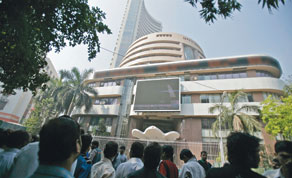
The BSE India Sensitive Index, or Sensex, sank 1.9% to 16,461.71 at the 3.30pm close yesterday in Mumbai, the most in Asia and the gauge’s biggest drop in almost two months. The measure has lost 20% this year on concern the record increases borrowing costs may combine with Europe’s debt crisis to hurt profits.
Earnings estimates may be cut as Asia’s third-largest economy slows, N Krishnan, head of India research at CLSA Asia- Pacific Markets, said.
India’s central bank last month forecast the $1.7tn economy will expand 7.6% in the year to March 31, lower than the 8% it estimated previously, as tight monetary policy and Europe’s debt crisis cools consumer demand. It has raised borrowing costs 13 times since mid-March 2010 to tame inflation that has exceeded 9% since November last year.
Twelve out of 30, or 40%, of the companies on the Sensex reported earnings that lagged behind analysts’ estimates for the September quarter, compared with 47% in the three months ended June, data compiled by Bloomberg show.
The rupee depreciated 0.3% to 50.9050 per dollar in Mumbai, according to data compiled by Bloomberg. The currency touched 50.9550 on Wednesday, the weakest level since March 2009.
“The outlook for the rupee is bleak as capital flows have dried up,” said Vikas Babu, a currency trader in Mumbai at Andhra Bank. “Europe’s debt crisis is deterring investors from emerging market assets.”
The drop in the Sensex has narrowed the gauge’s valuation to 14.3 times estimated profits from 21.5 times in March 2010. The MSCI Emerging Markets Index trades at 10.3 times, according to Bloomberg data.
“Indian valuations are below long-term averages and look attractive vis-a-vis long-term fundamentals,” Sivasubramanian said. “We don’t see sovereign-debt concerns having any major impact on India, except in an indirect way due to changes in global risk appetite and the impact on capital flows.”