By Santhosh V Perumal
Business Reporter
Turkey, which is fully supportive of Arab Spring, yesterday said it was seeking to enhance economic ties with the Arab world in general and Qatar in particular for investments and liquefied natural gas (LNG).

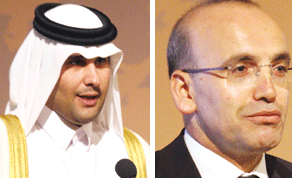
Sheikh Jassim and Simsek: Looking to build stronger ties
“Arab Spring is more than welcome. We fully support it,” Turkey’s Finance Minister Mehmet Simsek told the 3rd annual Qatar Global Investment Forum, hosted by QInvest.
It was quite exciting to see that people are finally achieving change, he said, adding in the long run, it (Arab Spring) would be great for the region in terms of growth and prosperity although in the short-term it caused disruptions in terms of trade and businesses.
Highlighting that the country’s export share to Europe has been shrinking, Simsek said Turkey has embarked on diversifying its market and added that the export share to the Middle East and Africa had more than doubled in the recent past.
Europe accounts for 58% of Turkey’s exports, 60% of tourists’ inflow and 80% of foreign direct investment.
“We want stronger bridges between Turkey and this (Arab) region (in general) and particularly with Qatar,” he said, adding that he was also aware that Qatar is interested in opening a bank in the country.
QNB, Qatar’s largest lender, had last month confirmed that it was in talks with Denizbank - the Turkish arm of embattled Dexia - to buy a controlling stake. Although the bank said negotiations were in the early-stages, Simsek said “we will more than welcome” (it if the deal goes through).
About LNG from Qatar, he said his country would be more than happy to be part of a major pipeline connecting the (Gulf) region to the European Union, or to have an LNG plant in Turkey to take Qatari gas to Europe.
Moreover, Turkey would also be interested in working together with Qatar, especially in the field of small and medium enterprises (SMEs), appreciating Doha’s focus on improving the quality of human capital; enhancing infrastructure and improving investment climate, Simsek said.
On the issues confronting eurozone, he said there was an urgent need to take steps to contain the deterioration in consumer confidence and market sentiment, which was having significant impact on the real economy.
Terming the recent G20 summit as “one of the most gloomiest”, Simsek said the eurozone was in the brink of recession and the overall world economic growth was uneven with growth coming from emerging markets when the developed economies were lagging and were not creating jobs.
Finding that the developed countries, including some nations in the eurozone, had huge primary deficits, he said the need of the hour was to move into primary surpluses, which called for massive adjustments.
Suggesting currency adjustments as one of the ways to bridge the current account deficits in eurozone, Simsek, however, said it was difficult since the zone involved 17 different governments, parliaments and fiscal policies.
QInvest chairman Sheikh Jassim bin Hamad bin Jassim bin Jaber al-Thani said European sovereign risk continued to create uncertainty with the markets assessing the risk of contagion as the story moved from Greece to Italy, and other European countries came under scrutiny.
Whilst the most recent data indicated the US market’s chances of avoiding recession were improving, longer term reduced growth rates might prevail, Sheikh Jassim said, adding other emerging markets in Asia, whilst positioned for long term favourable growth, were impacted with lower growth projections in the shorter term.
“This uncertainty, compounded by continuing concerns over potential systemic risk in Europe, continues to generate imbalances and extreme volatility in global markets. In this climate the skills and creativity of financial sector professionals are tested to the full in offering strategies to leverage opportunities that volatility and uncertainty may offer up,” Sheikh Jassim told the forum, which was supported by the Qatar Financial Centre Authority.