


 |
|
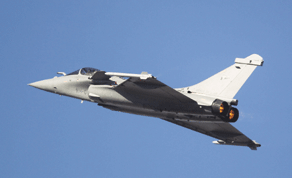
A Rafale fighter jet flies past at the Dubai Airshow. A long-awaited French deal for Dassault to sell at least 60 Rafale warplanes to the UAE hit a new snag yesterday when the Arab country’s crown prince said proposed terms were “uncompetitive and unworkable”. The deal, which had been in the works since 2008, was thrown into doubt earlier this week when it became clear that the world’s fourth-largest oil exporter had asked for details of a rival aircraft, the Typhoon built by the Eurofighter consortium. “Thanks to President (Nicolas) Sarkozy, France could not have done more diplomatically or politically to secure the Rafale deal,” Abu Dhabi Crown Prince Sheikh Mohamed bin Zayed al-Nahayan, deputy of the country’s armed forces, said in a statement, adding that Sarkozy’s “personal intervention in this process has sustained |
Gulf airlines can afford a little arrogance. Qatar Airways’ chief executive gave Airbus a blunt lecture on strategy at the Dubai Airshow, telling the European aircraft maker to “go back to basics” before changing tack and placing a $6bn order for at least 80 new planes—hot on the heels of a mega $18bn order for Boeing from Dubai-owned rival Emirates. The cash-and-swagger confidence may seem like hubris. But it underscores how Gulf carriers are gaining altitude over the industry.
There are two big advantages Gulf airlines have over rivals. Advancement in aircraft technology means many long-haul flights now require just one stop, and the Gulf is perfectly located between the East and West. A third of the world’s population is within a four-hour flight. What’s more, everything is new. Airports and aeroplanes are more efficient.
As for the trade unions, known for hampering the aims of Australia’s Qantas and British Airways to manage costs, well, they don’t exist.
Global airline industry net profit will shrink 40% next year to $4.9bn, or less than a third of 2010 levels, according to the International Air Transport Association. But three Gulf carriers are more than coping. Dubai-owned Emirates, the world’s largest airline by passenger numbers, accounted for roughly 20% of the industry’s profits last year. Eight-year old Etihad reckons it will break even this year. And Qatar Airways has made a net profit for the last two years with 30% year-on-year route expansion.
A weak global economy is expected to at least halve Middle East growth in passenger traffic from 20% last year. But it makes sense for Gulf carriers to continue full throttle with plane orders if they can remain profitable in a downturn.
The region’s airlines are forecast to have 2.9% EBIT margins next year, more than three times that of European airlines, according to Iata. And there are still many routes under-served or not handled at all by Gulf carriers, according to the Centre for Asia Pacific Aviation.
That explains why the Middle East is expected to account for around 11% of global commercial airplane orders between now and 2030.
Airbus and Boeing may have to get used to the lectures.
CONTEXT NEWS
* Qatar Airways returned to the table on Tuesday to sign a $6.5bn aircraft order with Airbus hours after cancelling an announcement at the last minute and telling the European aviation group to “go back to basics” at the Dubai Airshow.
* Chief Executive Akbar al-Baker made a second appearance to announce the firm order for five A380 superjumbos and 50 A320neo jets, plus options, hours after announcing an “impasse” in negotiations.
* “Price was not at all an issue,” al-Baker said of the stall in talks. “The issue was with the A320 aircraft. Since then, they have gone back to the drawing board and quickly fixed their issues.”
* Dubai-owned Emirates airline placed an $18bn order with Boeing on Sunday for 50 of its 777 aircraft.
* Boeing predicted that airlines in the Middle East would need 2,520 airplanes worth $450bn by 2030, while its European rival Airbus said it saw demand for 1,920 aircraft worth $347bn in the same period.
(The author is a Reuters Breakingviews columnist. The opinions expressed are her own)