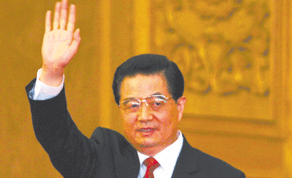
Beijing, Paris/AFP/Reuters
China’s state media yesterday warned that the country will not be a “saviour” to Europe, as President Hu Jintao left for an official visit to the region including a G20 summit.

All eyes on Hu Jintao as he visits Europe
Hu’s visit has raised hopes that cash-rich China might make a firm commitment to the European bailout fund, but in a commentary, the official Xinhua news agency said Europe must address its own financial woes.
“China can neither take up the role as a saviour to the Europeans, nor provide a ‘cure’ for the European malaise.
“Obviously, it is up to the European countries themselves to tackle their financial problems,” it said, adding that China could only do so “within its capacity to help as a friend.”
The Group of 20 major economies will meet in the French city of Cannes on Thursday and Friday, just a week after European Union leaders reached a last-ditch deal to tackle its debt crisis.
Europe is seeking to expand the European Financial Stability Facility (EFSF) to onetn euros ($1.4tn), possibly through a special purpose investment vehicle or the International Monetary Fund.
China, holder of the world’s largest foreign exchange reserves at $3.2tn, said it wanted more clarity before investing in the bailout fund after head of the EFSF Klaus Regling, held talks in Beijing to try to win help.
During his visit, Hu will first visit Austria to sign several “framework” agreements, including in the areas of economics and trade, before heading to the G20 meeting, Xinhua said in a separate report.
China’s Vice Foreign Minister Cui Tiankai said on Friday that the G20 should focus on the sovereign debt crisis in “developed countries” and the growing pressure of global inflation.
He added that members should make efforts to stabilise financial markets and restore investor confidence.
For its part, G20 partners will also be looking to China to stimulate domestic demand, diversify its export-led economic model and allow the yuan currency to appreciate more freely so as to slim down its massive trade surpluses.
Another Chinese official has played down hopes of a breakthrough at the G20 meeting. Vice Finance Minister Zhu Guangyao, also speaking on Friday, said investment in the European bailout fund was not on the agenda.
Beijing fears the financial risk of a major investment, which could also spark a domestic backlash as the Chinese public asks why they should bail out wealthier nations.
Already, opposition to such a move is being expressed on the Internet, on China’s hugely popular weibos – mcroblogging sites similar to Twitter – and in state media.
“China will only participate in a global programme that is defensible to the Chinese people. So don’t expect a ‘bailout’ or ‘rescue’ from China,” said China Macro Strategist for brokerage CLSA, Andy Rothman.
China has been burned before on overseas investment. It bought stakes in investment bank Morgan Stanley and asset management firm Blackstone only to see values collapse in the 2008 global financial crisis.
“China was taken in. Once bitten, twice shy,” said independent economist Andy Xie, former chief economist for Morgan Stanley.
Meanwhile, France’s opposition Socialists have attacked President Nicolas Sarkozy for seeking Chinese help in solving the eurozone debt crisis, tapping into voters’ concerns six months before a French presidential election.
Party leader Martine Aubry said Europe had been shown to be weak by turning to Beijing, following up on accusations by Socialist presidential candidate Francois Hollande that France had become “double dependent” on Germany and China.
A prominent member of Sarkozy’s centre-right UMP party, former prime minister Jean-Pierre Raffarin, told Journal du Dimanche that making a stand against China was pointless.
“We cannot go it alone. China has taken over the baton and become banker to the world. That’s the new deal of the 21st century,” he said.