Reuters/Moscow/London
Management at Anglo-Russian oil firm TNK-BP Ltd has asked its board of directors to sue shareholder BP for billions of dollars in damages over BP’s failed alliance with state-controlled rival Rosneft , sources said yesterday.

Dudley laughs off the latest legal twist
The move, revealed on the day both BP and TNK-BP announced their third-quarter results, threatens to add to the legal pressures already piling up on BP following its abortive attempt to partner Rosneft in exploring for oil in the Arctic.
The local shareholders in TNK-BP are already seeking an arbitration ruling that BP would be liable for damages, as the Rosneft deal violated a shareholder pact giving TNK-BP the right of first refusal on the British major’s deals in Russia.
Now the TNK-BP Ltd board will be asked to join litigation which has been started by a small shareholder in listed unit TNK-BP Holding which is due to be heard in a court in the Russian oil town of Tyumen on November 10.
“The management board has recommended to the board to consider doing this and it is expected that when it (the board) meets in November this issue will be discussed,” one source close to the local shareholders said.
The current litigant in Tyumen, shareholder Andrey Prokhorov, is claiming $13bn in damages against BP and a further $2.7bn against two BP nominees on the board of TNK-BP Holding for not involving TNK-BP in the Rosneft deal.
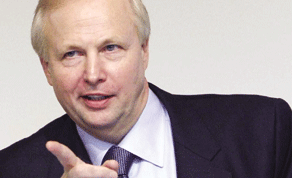
BP CEO Bob Dudley, speaking in London, laughed off the latest legal twist, likening TNK-BP to “a squabbling rock band” that plays on together despite artistic differences.
He said TNK-BP, which announced a 57% rise in third-quarter earnings to $2.3bn, continued to perform “extremely well”. TNK-BP’s CFO Jonathan Muir declined to comment at the company’s earnings news conference in Moscow.
TNK-BP is Russia’s third-biggest oil company and accounted for 1mn barrels of oil equivalent (boe) per day of BP’s production of oil and gas in the third quarter, contributing $928mn to BP’s net profits.
BP’s third-quarter replacement cost net profit rose to $5.14bn from $1.85bn a year earlier, when it took a charge related to the Gulf of Mexico disaster. Stripping out one-offs, BP earned $5.33bn.
A simple majority vote on the 11-member board of TNK-BP Ltd, a 50-50 joint venture between BP and a quartet of Soviet-born billionaires, would be necessary to pass the motion to join the damages lawsuit, sources said.
The board comprises four representatives from BP, four from the local shareholders and three independents: German former chancellor Gerhard Schroeder, the head of Russia’s industry lobby Alexander Shokhin, and former Corus CEO James Leng.
Two of the independents must back the initiative for it to be carried. In the past, when the board has faced controversial issues, the independents have tended to form a unified position after seeking outside counsel.
On Monday the board of TNK-BP Holding had voted against the listed company joining the $2.7bn lawsuit against two BP-nominated directors, since a near unanimous decision from the directors of the listed company was required.
Both the Financial Times and Russia’s Kommersant daily said yesterday that outgoing deputy chief executive Maxim Barsky had written to TNK-BP Ltd’s directors urging them to join the minority lawsuit.
The FT also quoted an opinion from two law firms that “there are strong grounds for the company pursuing legal claims arising out of the events involving BP and Rosneft.”
A source close to BP acknowledged that there had been an independent recommendation for TNK-BP to consider legal action. This would be discussed but it was unclear whether the board would vote.
“There are too many hypotheticals,” the source said after BP’s third-quarter results news conference.
Other sources close to BP say it continues to argue that the Russian court has no right to adjudicate over shareholder disputes, which should be heard under the so-called Stockholm arbitration process that operates under UK law.
BP, in its results statement, said the Tyumen cases were “wholly without merit”, that their chances of success were remote and it did not view them as a contingent liability.
That view is not shared by the local shareholders, who argue that because TNK-BP Ltd is not a party to the shareholders agreement its board can authorise management to take legal action outside the arbitration process.
Sources say the main focus of the dispute remains arbitration, which could pave the way for claims for damages against BP and its bosses in jurisdictions outside Russia.