


Zawya Dow Jones/Abu Dhabi
Inflation in Saudi Arabia is likely to drop back below 5% by the end of this year as international food prices stabilise and the cost of housing in the kingdom eases, the country’s central bank governor said yesterday.

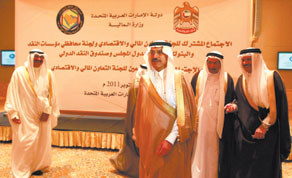
Saudi central bank governor Mohamed al-Jasser (second left) arrives with Kuwait’s central bank governor Sheikh Salem Abdulaziz al-Sabah (left), Gulf Co-operation Council secretary-general Abdul Latif al-Zayyani (right) and UAE central bank governor Sultan bin Nasser al-Suwaidi ahead of Gulf Central Bank Governors and Finance Ministers meeting in Abu Dhabi yesterday. Al-Jasser said yesterday he expects Saudi Arabia’s economy to grow by around 5% in 2011 and to remain around the same level in 2012
“The overall average inflation for this year has not exceeded 4.8%...and I would not expect it by the end of this year to be above 5%,” Mohamed al-Jasser, the head of the Saudi Arabian Monetary Agency, or Sama, told Zawya Dow Jones in an interview on the sidelines of a conference in Abu Dhabi.
Data released from the central department of statistics and information last week showed inflation accelerated to 5.3% in September, from 4.8% in August, a sign that the higher food prices and a hefty citizen-support package might be becoming an inflation headache for the kingdom.
Al-Jasser said September’s jump might have been “due to seasonal factors and perhaps Ramadan...volatility from month to month is expected, but we see inflation stabilising and commodities prices starting to decline”.
Saudi Arabia, a mostly desert country with scarce water supplies, imports the bulk of its food needs.
The International Monetary Fund warned in August that Saudi Arabia is likely to see inflation pressures from imported food prices, rents, increased government spending and high domestic liquidity. Inflation is likely to rise to an average of about 6% in 2011 from around 5% a year ago, IMF said.
Al-Jasser said yesterday he expects Saudi’s economy to grow by around 5% in 2011 and to remain around the same level in 2012.
“I am still optimistic that we will be close to 5% in terms of real GDP, and next year there shouldn’t be a marginal difference than that number too,” he said. Economic growth in 2012 will be dependent on crude oil demand and prices, al-Jasser added.
“It is very difficult when you are dependant on one commodity like oil it is difficult to calculate because it has a great sway on estimates,” he said.
Saudi Arabia remains concerned about Europe’s ongoing sovereign debt woes and is keeping close tabs on just how European leaders plan to combat the debt crisis that has spread to many regions across the eurozone.
“Everybody is watching what is happening in Europe this week and its reflections on the global economy. So if global economy goes into recession then oil and other commodities will be affected but if the signal from Europe is much more optimistic then oil prices will not decline and in fact should resume their rise,” al-Jasser said.
Despite some European banks recently selling assets to bolster liquidity, al-Jasser said Saudi Arabia wasn’t a ready buyer of distressed European or for that matter troubled US assets.
“We have a much more dynamic process of investing that doesn’t take opportunistic views of the market that there are distressed assets to buy. We have never done that in the past, we will not do it now, and we will not do it in the future,” al-Jasser said.