


Reuters/Tokyo
Japan’s Olympus Corp admitted yesterday it had paid $687mn to deal advisers, confirming claims made by its sacked CEO and reversing an earlier denial in a deepening scandal that has wiped out almost half its market value.

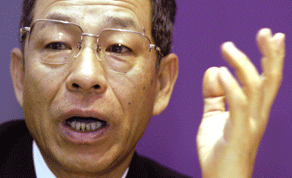
Chairman Kikukawa’s response to the crisis has not reassured investors
The maker of cameras and endoscopes earlier this week said it paid advisers a fee of some ¥30bn ($391mn) for a $2bn takeover of British medical equipment maker Gyrus in 2008.
In a statement yesterday, Olympus acknowledged the total payment was much higher when a buyback of preference shares was included.
Olympus confirmed the main allegation of its ex-CEO turned whistleblower Michael Woodford, a British national who says he was sacked after querying the payment. He was dismissed just two weeks into the job.
But Olympus refused to name the advisers and said it did not know their whereabouts. It had hired them to work on the Gyrus deal.
“The fee that Olympus paid for Gyrus is outrageously high,” said a senior investment banker in Japan, his comments reflecting widespread disbelief over a scandal that has put corporate Japan under the microscope. The banker asked not be identified due to the sensitivity of the issue.
The payment, equal to a third of the acquisition price, is stratospheric compared with an industry standard of 1% to 2% of a deal’s value. The manner in which it was paid has also shocked industry professionals.
Olympus has denied any wrongdoing, while Japanese regulators have made no comment on the issue. The Financial Services Agency declined to comment yesterday, and the Tokyo Stock Exchange has also made no suggestion of opening an investigation.
Woodford says his sacking last week was orchestrated by chairman Tsuyoshi Kikukawa for suggesting the chairman stand down over the payment, which exceeds the firm’s expected operating profit this business year.
The fired CEO has said he approached UK financial fraud investigators to probe the payment, most of which was made from the Japanese firm’s subsidiary in Britain.
Olympus said yesterday the payment included $620mn to buy back preference shares in Gyrus from its adviser in March 2010, or nearly quadruple the price at which Olympus issued them 18 months earlier in exchange for share options issued as part of the fees.
In its statement, Olympus said it paid a basic fee to the advisers of $5mn in June 2006 to help it unearth targets, make valuations, assist negotiations and for other standard services.
It said it had also agreed to pay 5% of the target price for a completed deal. Of that, 15% would be in cash and the rest in share options and warrants. It paid the adviser $12mn in November 2007, a week after unveiling the deal.
In September 2008, Olympus paid a further $50mn to buy the warrants and issued $177mn worth of preference shares in Gyrus to settle the outstanding options.
While Olympus did not name its advisers in its statement yesterday, Woodford has identified them as New York-based Axes America and Axam Investments in the Cayman Islands.
The advisers insisted on preferred stock as part of the payment because they “wanted to share in the future growth of the company and postpone recognition of their tax income liability,” according to an October 11 letter sent by Woodford to the Olympus board.
KPMG and law firm Weil, Gotshal and Manges advised against doing so, suggesting the company pay $200mn in cash.
The decision to issue preference shares proved costly.
In March 2010, Axam requested that Olympus buy back its holding of preference shares for $730mn. Olympus said it believed they were worth $519mn and the two sides agreed on the midpoint of $620mn, the October 11 letter showed.