Reuters/Jeddah
Saudi Arabia’s annual inflation rose to an eight-month high of 5.3% in September, boosted by price rises of miscellaneous products and services, while monthly price growth almost doubled, data showed yesterday.

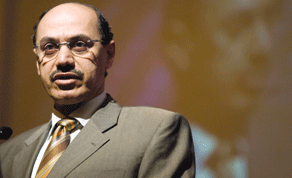
Mohamed al-Jasser
Inflation in the biggest Arab economy and world’s top oil exporter had hovered below 5% for most of 2011. It was 4.8% on an annual basis and 0.5% month-on-month in August.
Last month’s annual consumer price growth of 5.3% was the highest since January, while month-on-month inflation was 0.9%, Central Department of Statistics data showed.
“External pressures might have had some effect but this is mostly about domestic demand,” said Simon Williams, chief economist for the Middle East and North Africa at HSBC. “Public spending is rising faster than elsewhere and credit growth is recovering more strongly. We continue to look for an end-year reading of around 6%.”
Analysts had expected consumer prices to gain momentum this year after the government pledged early in 2011 to spend an estimated $130bn, or nearly 30% of annual economic output, on housing, job creation and other measures to improve social welfare over an unspecified period.
“Always in the second half of the year, which includes summer vacations, Ramadan, religious holidays and restarting of the schools, these factors result in increased spending and prices,” said Abdulhamid al-Amri, member of the Saudi Economic Association think tank. “I expect that from now until the end of the year the prices will continue rising.”
A Reuters poll of analysts in September forecast average inflation of 5.1% in 2011, slightly down from 5.3% in 2010.
Food costs, which account for 26% of Saudi consumer expenses, increased 0.4% month-on-month in September after a 1.5% jump in August, the data showed.
Housing and utility prices, making up 18% of the consumer basket, rose 0.6% after a 0.7% climb in August. The products and services component saw a 3.9% spike in September.
The International Monetary Fund said in August that the kingdom, which pegs its riyal currency to the US dollar, needed to keep a close eye on inflationary pressure following the planned increase in social spending.
But in a Reuters interview on Saturday, central bank Governor Mohamed al-Jasser said interest rate settings were appropriate at the moment with no signs of inflation coming from monetary stimulus.
Al-Jasser said earlier this month that he was “not worried” about inflation levels and expected them to continue to decline.
Saudi Arabia’s economy is forecast to expand 6.2% in 2011 following 4.2% growth in 2010, helped by robust crude oil prices and generous government spending, according to the analysts polled by Reuters last month. Growth is expected to slow to 4.5% next year, partly because of a weakening of the global economy.
‘Banks not directly exposed to Europe crisis’
Saudi Arabia’s central bank governor Mohamed al-Jasser said the kingdom’s banks are not directly exposed to the European debt crisis and therefore are not at risk. Al-Jasser was speaking to state-run al-Ikhbariya television in Paris.
The central bank is not interested in buying distressed or speculative assets such as troubled European debt and gold and the Opec member’s banks are well positioned to withstand the eurozone crisis, he said.
The world’s No 1 oil exporter like most of its Gulf Arab neighbours is a major holder of dollar assets as its riyal currency is pegged to the greenback and crude accounts for 85% of its budget revenue.
Asked if the Saudi Arabian Monetary Agency had considered buying European sovereign bonds such as Italian ones, al-Jasser told Reuters: “We do not buy specific bonds at all. We have not done it.”
“We always have a much more integrated reserve investment strategy which looks at it in a continuous and dynamic way that values security, safety and liquidity and therefore we do not look opportunistically at distressed assets or special assets that come up one way or the other,” al-Jasser said after a meeting of the Group of 20 countries in Paris.
The central bank of Saudi Arabia, which is the only Middle Eastern member of the G20 group of developed and emerging economies, rarely comments on its reserve strategy.
Gold, which has tumbled from a record high of above $1,920 an ounce, is another asset of little interest to the Saudi central bank due to its volatility, al-Jasser said.
“We have gold in our reserves but we have not bought and we have not sold it in a very long time. It has become a very speculative asset and we do not get into any speculative assets,” he said.
Asked whether the central bank was going to stick to this strategy, Jasser said: “Yes”.
Boosted by robust oil prices of above $100 per barrel this year, the Saudi central bank’s net foreign asset reserves have climbed steadily to a record high of 1.879tn riyals ($500bn) in August.
Gold reserves have been unchanged at 1.556bn riyals since 2008, the central bank’s data show.
Al-Jasser also said US Treasuries continued to be “an important safe haven and major asset” in global financial markets.
“62% of global reserves are still in US assets. It is safe to say they are there to stay for a while,” he said.
A downgrade of the US’ top-notch ‘AAA’ credit rating by Standard & Poor’s in August shocked the global markets but had no adverse impact on its bonds.