Reuters/Muscat/Dubai
Robust oil prices will help Oman balance its budget, the finance minister said yesterday, despite a jump in social spending which may have propelled inflation in the sultanate to a 29-month high in August.

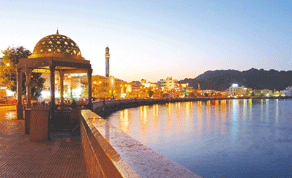
The Muscat skyline at sunset. Oman’s economic growth was projected to be 5% in 2012 and 5.5% in 2011 by Finance Minister Darwish al-Balushi yesterday
The small non-Opec oil producer was hit by protests earlier this year, prompting the government to boost budget spending by 14% over its original plan. Analysts said data yesterday showed the extra spending had fuelled a spike in the cost of personal care items.
“Oil prices have been supporting us. Although we anticipated at the beginning of the year a deficit, we think we will be able to break even, in spite of the additional spending the government has announced during the course of the year,” said Finance Minister Darwish al-Balushi.
Al-Balushi said he expected a $10bn aid package, pledged by wealthier fellow Gulf Arab oil exporters in March, to begin flowing in the first quarter of 2012. “Basically it’s going to be used to create jobs for Omanis,” he told reporters on the sidelines of an investment forum in the Omani capital. “Some of the countries have acted more quickly than the others but eventually, all will come.”
The government promised a 1bn rial ($2.6bn) spending package in April after nearly two months of protests. Since then there has been no significant unrest.
Yesterday, al-Balushi said economic growth was projected to be 5% in 2012 and 5.5% in 2011. Analysts polled by Reuters in September forecast 4.0% growth in 2011 and 4.2% next year after an estimated 4.1% in 2010.
“Next year we are looking for 5% (growth) as long as the oil price sustains in the range of $80 and above. Our break even is a little above $80. But $80 will keep us—and I think everybody—comfortable,” he said.
The sultanate based its 2011 budget on a projected oil price of $58 per barrel and expected expenditures of 8.1bn rials and a deficit of 850mn rials, or 3.8% of gross domestic product before the unrest started in February.
The Reuters poll forecast a surplus of 5.0% of gross domestic product for 2011.
The budget surplus widened to 736.5mn rials, or 3.3% of GDP, at the end of August, finance ministry data showed yesterday.
The country sold its oil at an average price of $101 per barrel in January-August.
Oman, which has the lowest government debt among Gulf Arab oil exporters at 5.1% of GDP, plans to issue about 150mn rials in development bonds this year. There are no plans to issue sovereign debt internationally, al-Balushi added.
Inflation in the country, which pegs its rial currency to the dollar, accelerated to 5.3% year-on-year in August from July’s 4.6%, the data showed, above the central bank’s full-year forecast of 4%.
On the month, consumer prices soared by 1.4% with the last such a jump seen ahead of the global financial crisis in June 2008, fuelled mainly by a 10.4% spike in personal care items.
“Post crisis, it is a high figure,” said Giyas Gokkent, chief economist at the National Bank of Abu Dhabi. “I assume that this (increase in personal care items) is a sort of one-off thing and this factor is going to fade away. We are assuming the headline reading for the sultanate CPI to ... hover around 5% in 2011,” he said.
The central bank said in June that inflation may rise due to government spending aimed at soothing social tensions.
Sticking with US debt; avoiding Europe
Oman’s central bank will keep investing in US Treasuries and it has also instructed local banks not to expose themselves to “toxic European debt”, Executive President Hamood Sangour al-Zadjali told Reuters yesterday.
Gulf states like Oman, which mostly peg their currencies to the US dollar, are major holders of US assets, with oil—priced in dollars—their main source of revenue.
A downgrade of the US’ credit rating by Standard & Poor’s in August prompted China, the top foreign holder of US government debt, to call for a new stable reserve currency.
“We are still keeping our investment in US Treasuries because no one else is pulling out their investments,” al-Zadjali said on the sidelines of a financial forum.
He said there would be no change in the central bank’s reserve policy and it would maintain its small gold holding.
Its foreign assets including gold, stood at 4.9bn rials ($12.8bn) in August, 3.5% down from a year ago, data showed yesterday. Al-Zadjali comments back up those of a senior Omani government official, who told Reuters in the immediate aftermath of the US rating cut that the sultanate would stick with US government paper.
Central banks around the world have held US Treasuries for their liquidity and safe-haven status.
Indebted European banks have been turning to the oil wealthy Gulf region for funding as they struggle to cope with the euro zone debt crisis, but al-Zadjali said the regulator had urged local banks to be cautious.
“We have instructed local banks not to expose themselves to toxic European debts. That is why they are not affected by the European credit crisis,” he said.
Meanwhile, Qatar had shown interest in setting up an Islamic bank in the Gulf Arab sultanate, al-Zadjali said. However, the plans had not been finalised, he said.