Reuters/Dubai
Egypt’s benchmark slumped to a 19-month low after clashes between military police and Coptic Christians in Cairo left 24 people dead and more than 200 injured, while Saudi Arabia’s index rose for a fourth session.

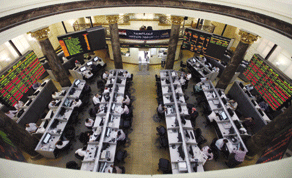
The trading room of the Egyptian stock market in Cairo. The bourse opened 5% lower and closed 2.3% lower at 3,938 points yesterday
Cairo’s bourse opened 5% lower in its biggest decline since the Egyptian Exchange reopened following a seven-week shutdown due to the popular uprising that toppled President Hosni Mubarak. The index closed 2.3% lower at 3,938 points.
In Saudi Arabia, insurance stocks rallied as upbeat sentiment in world stocks lent support. The benchmark rose 0.6%.
“There is volatility and an uncertainty trend for the market ahead of the Q3 results,” said Tarek Al-Madi, an independent Riyadh-based financial analyst.
Saudi Re of Cooperative Insurance jumped 8.6%, accounting for the largest exchange of shares.
Sanad climbed 0.7%.
“The leader stocks and the insurance stocks are the top-picks for the speculative and long-term investors, because of their high liquidity,” he said. “The market will take the cue from results of the leader stocks like Sabic and Al-Rajhi and then the speculative trading will start on the rest of the stocks.”
Saudi Basic Industries Corp (Sabic), the world’s largest chemicals producer, gained 0.5%. Yanbu National Petrochemical climbed 1.1%.
Petrochemical stocks were supported by gains in oil prices, which impact their bottom line.
Banks also rose with Samba Financial Group up 1.2%. But bellwether Al-Rajhi Bank ended flat.
World stocks and the euro rose yesterday after German and French leaders promised to announce fresh steps to tackle the eurozone debt crisis by the end of the month.
In UAE, property stocks fell as Emaar Properties shed 1.5%. Dubai’s index dipped 0.6%.
Analysts polled by Reuters expect Emaar’s net profit to drop by about 37%.
Builder Arabtec slipped 2.3%.
Abu Dhabi’s Aldar Properties declined 1.8% and Sorouh Real Estate shed 1.9%.
“Especially with real estate companies in UAE, I don’t think we will see any positive surprises,” said Shakeel Sarwar, head of asset management at Securities & Investment Co (Sico) in Bahrain. The sector is going through a consolidation phase and the view right now is long term.”
Abu Dhabi’s benchmark eased 0.07%, extending 2011 losses to 8.2%. Dubai’s index fell 0.6% to 1,390 points.
Elsewhere, Oman’s index climbed 0.05% to 5,567 points; Kuwait’s measure eased 0.08% to 5,848 points and Bahrain’s measure slipped 0.9% to 1,154 points.