Reuters/Tokyo
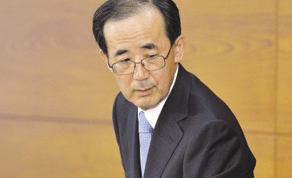
The Bank of Japan governor warned yesterday that the country’s economic recovery faces increasing threats from Europe’s sovereign debt woes and a slowdown in global growth, reflecting similar comments from other central banks this week.

The warning by Bank of Japan governor Masaaki Shirakawa suggests the central bank, which left policy unchanged yesterday, is now less convinced that Japan’s economy will resume a moderate recovery by the end of 2011
The warning by Masaaki Shirakawa suggests the central bank, which left policy unchanged yesterday, is now less convinced that Japan’s economy will resume a moderate recovery by the end of 2011. That underlined expectations of further policy easing in the months ahead.
The Bank of Japan has maintained the economy will recover moderately, supported by reconstruction spending following the March earthquake and tsunami that tipped it into recession and the resilience of emerging markets. But it has also said it stood ready to ease policy if risks increased.
“Global growth is slowing as a trend, mainly in advanced economies. European growth is stalling as broadening debt woes start to affect its economy via worsening business and household sentiment,” Shirakawa said in a news conference.
“We need to focus on downside risks to Japan’s economy given uncertainties in overseas developments and unstable currency and other market moves,” he said.
As widely expected, the BoJ kept its policy rate unchanged in a range of zero to 0.1% and maintained the size of an asset buying scheme at ¥15tn ($195bn).
Worries that Europe’s debt woes may escalate into a global banking crisis have roiled global markets.
On Thursday, the Bank of England launched a second round of quantitative easing. Central bank governor Mervyn King said the euro zone crisis was severely straining financial markets.
On the same day, the European Central Bank threw a lifeline to struggling banks with president Jean-Claude Trichet citing “intensified” threats to the eurozone economy.
Federal Reserve chairman Ben Bernanke said he stands ready to take further steps if need be to support a US economy he described as “close to faltering.”
“Uncertainty over Europe remains and there is a possibility that more negative news will come out of the region,” said Yuichi Kodama, chief economist at Meiji Yasuda Life Insurance. “I think there is still a 50% chance of additional easing by the BoJ this year.”
While holding off on easing policy, the BoJ extended by six months a ¥1tn scheme set up after the quake that offers cheap loans to banks in the disaster-hit regions. The programme expires this month although so far only ¥449bn has been used.
Shirakawa has maintained that the central bank is already proceeding with powerful monetary policy easing. He fended off lawmaker calls this week for more action, reminding them that the BOJ had already done much to protect the economy when it eased policy in August.
But he said yesterday the central bank needed to be on its guard: “We need to carefully watch whether additional risks due to increased global economic uncertainty will materialise and lead to a slowdown of the (Japanese) economy.”
That may be preparing the way for the BoJ to cut its economic forecasts in a twice-yearly report on October 27, when it will also review policy, and so flag a delay in the recovery from the March disaster.
The BoJ will likely cut its GDP forecasts in the semi-annual report, sources familiar with central bank thinking say, and project that core consumer inflation will stay below the 1% threshold that it sees as desirable price growth until the year to March 2014 - signalling that it will keep interest rates ultra-low until then.
A major overhaul in its projections may give the BoJ justification to ease policy again, particularly if there is more evidence that the economy is losing momentum or if the yen rallies again against the dollar, analysts say. The BoJ loosened policy in August by boosting its asset buying scheme, aiming to forestall potential risks to Japan’s economy.
Govt okays $156bn quake budget plan
Japan’s government approved yesterday the outline of a $156bn extra budget and a plan to raise taxes from next April to fund rebuilding from the March earthquake, both of which will require opposition backing to pass through a split parliament.
The ruling Democratic Party has begun talks with combative opposition parties that control the upper house to secure their support, aiming to submit bills later this month, but it could struggle to get support for key revenue provisions.
The ¥12tn ($156.45bn) budget earmarks ¥9.1tn for disaster-related spending, including ¥6.1tn for reconstruction projects and more than 1tn yen for subsidies and other measures to help industry cope with the strong yen.