


AFP/London
 |
|
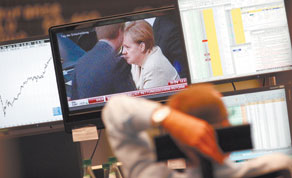
A trader watches a news broadcast showing German Chancellor Merkel at the Frankfurt stock exchange yesterday. Merkel won a vote on enhancing the eurozone’s bailout fund, lifting European markets. |
European and US stock markets jumped yesterday after Germany’s parliament voted overwhelmingly to boost the eurozone rescue fund and positive US growth and unemployment figures.
Frankfurt’s Dax 30 index rose 1.52% at 5,555.07 points, Paris’ CAC 40 advanced 1.8% to 3,050.06 points, while in London the FTSE 100 added 0.37% to 5,237.16. Madrid won 1.57% and Milan shot up 2.17%.
The German parliament passed a beefed-up rescue fund for stricken eurozone countries by a large majority yesterday in a vote seen as crucial to stem financial market turmoil.
German Chancellor Angela Merkel meanwhile averted political disaster as an overwhelming majority of her own deputies voted in favour of the proposal.
The vote before the Bundestag lower house on expanding the €440bn ($599bn) bailout fund was also seen as a crucial test of Merkel’s authority amid fears of a major backbench rebellion.
“Stocks jumped ... as investors digested news that the German parliament had easily passed a vote to allow the July changes to the EFSF rescue fund, although the euro fell back from its highs of the session,” said Kathleen Brooks, an analyst at traders Forex.com.
The European single currency climbed to $1.3613 from $1.3536 late in New York on Wednesday. The dollar rose to ¥76.73 from ¥76.53 on Wednesday.
“The euro has managed to sustain the rally that began on Monday; however news that Germany had passed the vote on the EFSF hasn’t triggered a relief rally,” Brooks said.
“This could be because a lot was priced in already, but the euro may remain stuck in a range for some time yet.”
German deputies voted by 523 to 85 in favour of expanding the size and the scope of the European Financial Stability Facility (EFSF). Three abstained.
Germany became the 11th of 17 eurozone states to agree to beef up the EFSF and hand it new powers, for example to buy bonds of struggling nations.
Also yesterday, international auditors resumed talks in Greece to decide whether the government in Athens was doing enough to merit more financial aid, amid mounting social tension over the government’s austerity measures.
Greek Prime Minister George Papandreou has said that Athens was making a “superhuman effort” to bring down its debt.
Wall Street opened strongly after a revision of second quarter US growth to 1.3% from 1%, and US jobless claims falling sharply last week to 391,000, their lowest level since April.
Ten minutes into trade, the Dow Jones Industrial Average was up 1.85%, while the broader S&P 500 added 1.7%, and the Nasdaq gained 1.6%.
“US stocks are pointing nicely higher in early trading on Thursday, aided by some favorable US economic data and the approval of the expansion of the eurozone’s bailout fund by Germany,” said brokerage Charles Schwab.
All 30 Dow blue chips were higher, with embattled Bank of America leading the pack with a 4.5% rebound, after Wednesday’s nearly 5.0% drop.
Chip-maker Advanced Micro Devices, which lowered its third quarter forecasts after the market closed on Wednesday, lost 9.8%.
On-line retailer Amazon was down 1.1% a day after launching its new $199 tablet computer aimed at Apple’s iPad, which goes for more than double the price.
Apple shares rose 0.3%.
The bond market was mixed. The 10-year Treasury bond yield was at 2.02% compared to 2% late Wednesday, while the 30-year yield fell to 3.07% from 3.09%.